Monday, October 5, 2015

China’s Nightmarish Citizen Scores Are a Warning For Americans and Taiwanese

China’s Nightmarish Citizen Scores Are a Warning For Americans and Taiwan


By Jay Stanley, Senior Policy Analyst, ACLU Speech, Privacy & Technology Project


China is launching a comprehensive “credit score” system, and the more I learn about it, the more nightmarish it seems. China appears to be leveraging all the tools of the information age—electronic purchasing data, social networks, algorithmic sorting—to construct the ultimate tool of social control. It is, as one commentator put it, “authoritarianism, gamified.” Read this piece for the full flavor—it will make your head spin. If that and the little other reporting I’ve seen is accurate, the basics are this:

  • Everybody is measured by a score between 350 and 950, which is linked to their national identity card. While currently supposedly voluntary, the government has announced that it will be mandatory by 2020.
  • The system is run by two companies, Alibaba and Tencent, which run all the social networks in China and therefore have access to a vast amount of data about people’s social ties and activities and what they say.
  • In addition to measuring your ability to pay, as in the United States, the scores serve as a measure of political compliance. Among the things that will hurt a citizen’s score are posting political opinions without prior permission, or posting information that the regime does not like, such as about the Tienanmen Square massacre that the government carried out to hold on to power, or the Shanghai stock market collapse.
  • It will hurt your score not only if you do these things, but if any ofyour friends do them. Imagine the social pressure against disobedience or dissent that this will create.
  • Anybody can check anyone else’s score online. Among other things, this lets people find out which of their friends may be hurting their scores.
  • Also used to calculate scores is information about hobbies, lifestyle, and shopping. Buying certain goods will improve your score, while others (such as video games) will lower it.
  • Those with higher scores are rewarded with concrete benefits. Those who reach 700, for example, get easy access to a Singapore travel permit, while those who hit 750 get an even more valued visa.
  • Sadly, many Chinese appear to be embracing the score as a measure of social worth, with almost 100,000 people bragging about their scores on the Chinese equivalent of Twitter.
A few years ago I wrote a piece about how the fall of the Soviet Union, for all its benefits, has made it harder to defend privacy in the United States. During the Cold War, I argued, we defined ourselves in opposition to an enemy that exemplified and embodied in very real form the nightmarish potential of widespread surveillance and control. This made it easy to point to surveillance and shout, “un-American!”
We have thankfully seen the end of the old totalitarian regimes, but often they have been replaced by authoritarian regimes, which operate with free markets and greater personal freedom, but continue to apply just enough power to stave off threats to their rule. Arrests, beatings, imprisonment, and shootings are such crude tools for the silencing of political opposition and dissent—so much subtler and more effective topressure people, to turn the exercise of power from a hammer, striking the body politic from without, into a drug, which permeates social life from within and shapes it in the desired directions. In today’s world, all the tools are in place to allow a government to do just that in stunningly subtle yet powerful ways, and the Chinese government appears to be wasting no time in exploiting that potential to the fullest.
The United States is a much different place than China, and the chances that our government will explicitly launch this kind of a program any time in the near future is nil, but there are consistent gravitational pulls toward this kind of behavior on the part of many public and private U.S.bureaucracies, and a very real danger that many of the dynamics we see in the Chinese system will emerge here over time. On the government side, for example I have written about how the TSA’s airline passenger “white list” system could evolve in this direction. In the private sector, Frank Pasquale notes that elements of its judgment-and-reward system already exist in the U.S. private-sector credit scoring infrastructure.
I hope this new Chinese system becomes household knowledge in the United States, and can provide the kind of widely recognized paradigm for what to avoid and how not to be that the old totalitarian regimes used to give us. At the ACLU we are constantly warning of the dangers of abuses of power, and often the dangers we cite, while well-founded, consist of potential futures, leading critics to say we’re being “merely theoretical.” With this Chinese system, a whole range of things we’ve warned about are no longer theoretical.
In China, Your Credit Score Is Now Affected By Your Political Opinions – And Your Friends’ Political Opinions

China just introduced a universal credit score, where everybody is measured as a number between 350 and 950. But this credit score isn’t just affected by how well you manage credit – it also reflects how well your political opinions are in line with Chinese official opinions, and whether your friends’ are, too.
In the West, the surveillance agencies have been trying to stay as low-key as possible, while listening to everything and anything. China has taken a different approach. Not only is the surveillance very overt, you are also constantly nudged to fall in line.
This Chinese credit score, which seemed innocent at first, was introduced this summer. More precisely, it was introduced by Alibaba and Tencent, China’s IT giants who run the Chinese equivalents of all social networks, and who therefore have any and all data about you. People can download an app named “Sesame Credit” from the Alibaba network, and the score has become something of a bragging contest, being interpreted as a kind of “citizen status” – and not entirely falsely so. Almost 100,000 people have posted their “status” online on Weibo, the Chinese equivalent of Twitter.
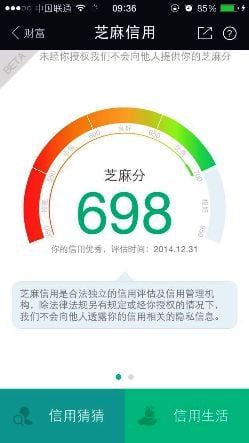
A screenshot from the Sesame Credit app, showing score 698 on a scale from 350 to 950.In the West, our credit score is simple. It’s our ability to pay. It’s measured from our assets, our income, and if we have bought on credit in the past and managed it well. That’s it. In China, the situation is… morenuanced. It’s not just that you have bought things, it’s also what you buy that contribute to your credit score, in either direction. If you’re buying things that the regime appreciates, like dishwashers and baby supplies, your credit score increases. If you’re buying videogames, your score takes a negative hit.
Anybody can check anybody’s credit score using the site Credit China, which again helps people disconnect from people who significantly draw down your own credit score: they’re listed as such. All 869,582 of them.
In theory, Sesame Credit (and its benefits) is optional. So far. For the time being. But China has already announced that it, or something very like it, will become mandatory from 2020. It has also announced that while there are benefits today for obedient people, it intends to add various sanctions for people who don’t behave, like limited Internet connectivity. Such people will also be barred from serving in certain high-status and influential positions, like government official, reporter, CEO, statistician, and similar.
Things that will make your score deteriorate include posting political opinions without prior permission, talking about or describing a different history than the official one, or even publishing accurate up-to-date news from the Shanghai stock market collapse (which was and is embarrassing to the Chinese regime).
But the kicker is that if any of your friends do this — publish opinions without prior permission, or report accurate but embarrassing news — your score will also deteriorate. And this will have a direct impact on your quality of life.
“Sesame Credit, however, also uses other data to calculate the scores, such as a person’s hobbies, interaction with friends, shopping habits and lifestyle.” — Quote from China Daily Asia
The KGB and the Stasi’s method of preventing dissent from taking hold was to plant so-called agents provocateurs in the general population, people who tried to make people agree with dissent, but who actually were after arresting them as soon as they agreed with such dissent. As a result, nobody would dare agree that the government did anything bad, and this was very effective in preventing any large-scale resistance from taking hold. The Chinese way here is much more subtle, but probably more effective still.
This scheme is far more sinister than it seems at first, as you’re also getting assorted immediate privileges based on this credit score:
If your credit score reaches 600, you have the privilege of an instant loan of about $800 without collateral when shopping online.
At a score of 650, you may rent a car without leaving a deposit.
At 700, you get access to a bureaucratic fast track to a Singapore travel permit.
And at 750, you get a similar fast track to a coveted Schengen visa.
There are many more examples – these are just to illustrate.
Do you see what’s happening here? This means that people need to choose between that coveted European vacation and keeping in touch with their old friends who are disagreeing with the regime’s opinions openly. This means that staying in touch with dissidents will cause you and your family to lose out on social benefits. As a result, this will very effectively isolate and neuter anybody who posts unofficial political opinions or unofficial history facts. They’ll effectively be sent into social exile, based on everything they do, write, think, and discuss online.
What China is doing here is selectively breeding its population to select against the trait of critical, independent thinking. This may not be the purpose, indeed I doubt it’s the primary purpose, but it’s nevertheless the effect of giving only obedient people the social ability to have children, not to mention successful children.
People sometimes mock the notion that we’re not at a 1984 level yet. I wonder what it’ll really take to make such people realize that the 1984 point of surveillance has long come and gone.
Privacy remains your own responsibility.
H/t Kit (in Swedish).
UPDATE: Here’s a link to the official directive (in English) to construct this Chinese “social credit score” by 2020. As commented on Hacker News, this Sesame Credit appears to be a trial for the official requirement. Link added inline to text above as well.

Tuesday, September 29, 2015

Mass lay-offs in Heilongjiang add to China’s coal industry woes

You are here

The Longmay Mining Group, the largest coal mining company in northeast China, will lay off 100,000 employees, about 40 percent of its current workforce, over the next three months, company chairman Wang Zhikui announced last week.
The Longmay Group has been badly hit by the slowdown in the coal industry over the last two years. Production costs in Longmay’s mines are relatively high but coal prices have plummeted leading to a reported loss of six billion yuan last year despite a three billion yuan bailout from the Heilongjiang provincial government.
On 6 April this year, thousands of workers at Longmay’s Qitaihe Mine went out on strike demanding payment of three month’s wages in arrears. Two weeks later on 20 April, several hundred workers at apower company under Longmay went on strike after the company suddenly halted production. Soon afterwards Longmay announced plans to close another eight mines that were nearing the end of their production cycle.
Several thousand workers at the Longmay Qitaihe Mine protest the non-payment of three month's wages
Longmay’s problems are far from unique. The China National Coal Association reported on 23 January 2015 that more than 70 percent of China’s coal companies were making a loss, and there is little indication that the situation has improved this year.
CLB's Strike Map has recorded 57 strikes and protests in the mining industry so far this year, nearly all of which have been related to low pay, the non-payment of wages and benefits, or mine closures. Just in the last week, there were three separate wage arrears protests by miners in Shanxi, Henan and Shaanxi.
Most of these protests involved a few hundred miners, suggesting that it is predominately smaller coal mining companies that are affected, but there were at least half a dozen protests involving thousands of workers, including a strike by 3,000 miners in Chongqing on 13 May protesting the mine’s sudden closure.
The proposed layoffs in the Longmay group will certainly lead to more tension with the workers. The company claims it will manage the process through early retirements and re-employment programs but Longmay’s track record suggests the workers themselves will be forced to accept whatever they are offered.
Following the massive explosion that killed 171 miners in Longmay’s Dongfeng Mine in November 2005, local government and company officials forced the bereaved families to accept the compensation deal on the table as quickly as possible by threatening financial penalties for every day they did not.

Wednesday, September 9, 2015

Anger over China’s Deadly Workplaces after Warehouse Explosion

Anger over China’s Deadly Workplaces after Warehouse Explosion

 31 13
 
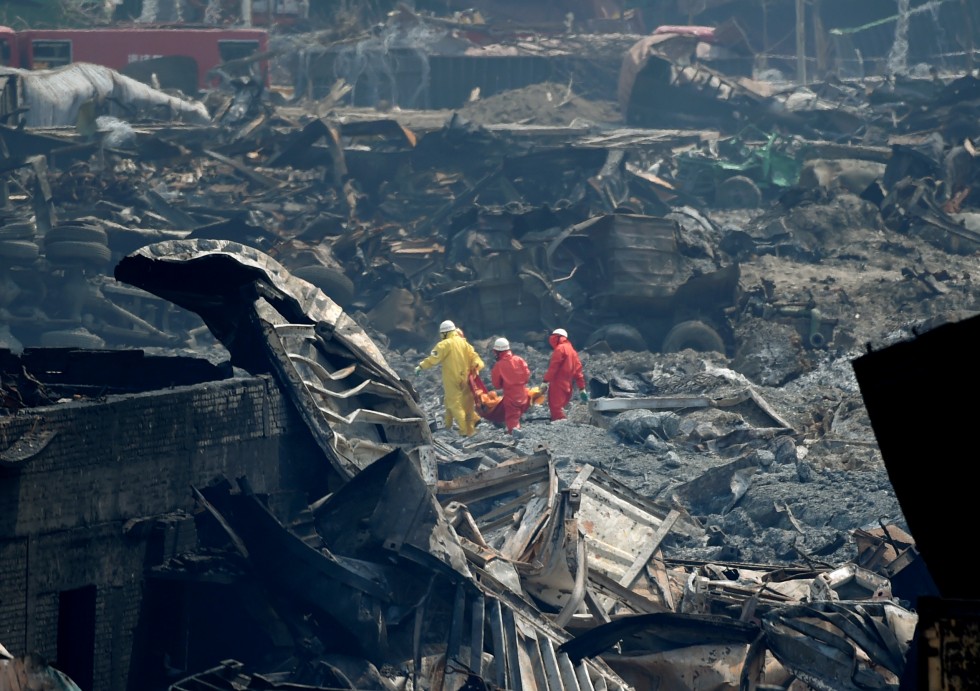
A series of chemical explosions on August 12 at a warehouse in Tianjin is shining a spotlight on dangerous workplace conditions and precarious employment relations in China. Photo: Xinhua.
A series of chemical explosions on August 12 at a warehouse in the northern city of Tianjin is shining a spotlight on dangerous workplace conditions and precarious employment relations in China.
The accident began with fires at a warehouse owned by Rui Hai International Logistics. The company was storing illegal quantities of sodium cyanide—a highly toxic and volatile substance. Investigators at the site have also found hundreds of tons of fertilizers and other hazardous chemicals.
Firefighters reportedly sprayed water on the flames, which may have contributed to a chain reaction. Two gigantic explosions were large enough to register as minor earthquakes. Fires and secondary explosions raged on for days, creating serious concerns about air and water contamination.
The accident has already claimed 145 lives and injured more than 700. Some are still missing. The casualties include employees of the logistics firm, other workers near the blasts, firefighters, and local residents. Apartments miles from the industrial park suffered broken windows, while poorly constructed dormitories nearby simply collapsed, injuring rural migrant workers inside.
What began as an industrial accident has quickly become an environmental disaster. The week after the blasts, when the first rains came, residents reported a white foam covering the streets and a stinging sensation on their skin. Thousands of dead fish floated to the surface of the nearby Hai River.
For fear of contamination, authorities evacuated residents near the blast site. Military units and biochemical specialists were sent to clean up the area.
Hundreds of displaced residents took to the streets to call for compensation. The families of dead and missing firefighters demonstrated to demand more information and transparency.

WORKPLACE HAZARDS ABOUND

This is one of China’s worst industrial accidents in recent years, but it’s by no means isolated. Three decades of breakneck industrialization have produced a long trail of disasters.
The government does not publish statistics on industrial accidents. But the Hong Kong-based China Labour Bulletin’s Work Accident Map has recorded some 370 industrial accidents since December 2014. The majority are in construction, mining, and manufacturing. Most include fatalities as well as injuries.
Such incidents rarely receive the public and media attention that the Tianjin blasts have gotten. Few are thoroughly investigated, and it’s rare that workers or their families are fairly compensated.
Until recently, mining accidents were the most notorious source of workplace injury and death. Six to seven thousand miners died each year in the early 2000s, in accidents caused by dust explosions, mine collapses, and floods. After a 2005 disaster, authorities cracked down on illegal and unsafe mines, and the death toll declined. Even so, in 2013, 1,000 Chinese miners died on the job.
Many more suffer from lung diseases. Six million workers have pneumoconiosis, and in the majority of cases it’s probably caused by dust inhalation in coal mining. They face huge costs for medical treatment, with little compensation from management and the government.
Factory fires and explosions are common too, particularly in manufacturing, where management and local authorities routinely ignore safety. A 2013 fire at a poultry plant in Jilin Province killed 121 people. Last year, a dust explosion at an auto parts plant in Kunshan, Jiangsu Province, killed 146. The China Labour Bulletin reported 26 workplace explosions this year before Tianjin, causing 65 deaths and 119 injuries.
Most of these companies lack effective union representation, so workers have no way to report and address problems.

Review: Behind China's Wildcat Strike Wave

China is the world center of wildcat strikes—given that no strike in China is officially allowed under the law. The government doesn’t issue statistics, but one source found 1,171 strikes and worker protests from June 2011 through 2013.
Strikes are on the rise since 2008, but they all take place outside the official channels of the All-China Federation of Trade Unions. China labor scholar Eli Friedman, who speaks Mandarin and has spent a great deal of time in the country, shows us throughout his book Insurgency Trap how the ACFTU takes a “passive repressive” response to worker unrest—and sometimes not so passive.
His case studies show how in even the supposed best examples—the ones that ACFTU officials show to visiting foreign unionists—workers find their union worthless and contracts go unenforced.
Read more here.
—Jane Slaughter

FIREFIGHTERS ARE TEMPS

Eighty-eight firefighters were killed in the Tianjin blast. Even as the government hails them as national heroes, the casualties have called attention to their precarious employment conditions.
Many firefighters in China are employed on “dispatch labor contracts.” In theory this means they’re asked to sign a one- to two-year contract with a labor contractor, then dispatched to work for companies. In practice, companies often recruit workers directly, then force them to sign dispatch contracts afterwards.
This setup allows employers them to avoid establishing any legal contractual relationship with their employees. Workers on dispatch contracts receive lower salaries and fewer benefits than those on regular contracts. When accidents like this happen, they often receive much less compensation—and it’s not always clear who’s even responsible for paying it.
This particular form of casualization has expanded since the Chinese government passed the 2008 Labor Contract Law, supposedly designed to protect workers’ job security. To bypass the law, employers started using more dispatch labor. The central government, responding to public criticism, amended the law in 2014 to reduce casualization—but there’s no evidence the amended law has been forcefully implemented.
Among the worst offenders are state-owned enterprises and government institutions, which have sharply increased casualization to cut labor costs. In some state-owned enterprises, casual workers make up over 50 percent of the workforce—even though the legal limit is 10 percent.
Most of the Tianjin firefighters who died were on such contracts. So were many of the workers in the warehouse that exploded.
There is no union specifically for firefighters in China. The district trade union that’s supposed to represent those in Tianjin responded to the disaster by passing out a self-help handbook.

PUBLIC BACKLASH

The public backlash has forced the Chinese government to launch a nationwide investigation into businesses that produce and store hazardous materials. Linking the disaster to corruption and a failure of regulatory oversight, the government is also investigating the company and local authorities. Already it has detained 11 high-level local officials and 12 senior company managers, and the chief of the State Administration of Work Safety has been sacked on suspicion of “serious breaches of discipline and the law.”
The government’s actions are a tacit acknowledgment of public concern for the environment, and of China’s emerging environmental movement. Over the past decade, urban residents in Xiamen, Dalian, Maoming, Kunming, Shifang, and most recently Shanghai have protested petrochemical and incineration plants that were slated to be built near concentrated residential areas. Usually they’ve won, getting the plants relocated or cancelled.
Although they come at tragic human costs, the new investigations and stepped-up regulatory enforcement are steps in the right direction. But ultimately, to fight for better health and safety standards and to avoid any more tragedies, workers will need to build strong, democratic unions.
China’s official union, the All-China Federation of Trade Unions (ACFTU), has sought to set up unions at more and more companies. But even in most of these unions, workers cannot democratically elect their representatives. Recent experience suggests the most effective unions are those elected by workers after successful strikes.
Kevin Lin is a Ph.D. student researching labor politics in China.
- See more at: http://labornotes.org/blogs/2015/09/anger-over-chinas-deadly-workplaces-after-warehouse-explosion#sthash.9fnkaNZw.dpuf

Pressure builds on Walmart in Shenzhen as trade union activists fight back

You are here

Pressure builds on Walmart in Shenzhen as trade union activists fight back

Sacked Walmart workers in Shenzhen are joining forces to put pressure on the world’s largest retailer to curtail its harassment of labour activists and genuine trade unionists.
Yu Zhiming, a democratically elected member of the union committee at Walmart Store No. 5722 in Shenzhen’s Nanshan district, took the company to arbitration court for illegal dismissal earlier this year and won. He has now teamed up with veteran Walmart worker activist, Wang Shishu, who is also suing the company after being dismissed for a second time earlier this year.
Yu, 43, from the central province of Hubei, had worked in the seafood department at the No. 5722 store since 2002. He was elected to the store union committee in 2013:
“All of the six committee members and the union president were democratically elected, and we were doing a good job,” Yu said. “I am very proud to say that our union was the only one in Shenzhen that was functioning as it should and was not controlled by management.”
The store union committee tried to bargain for better working conditions and, in September 2013, refused to endorse a new company rule that allowed managers to fire any employee who disobeyed three orders. The management-controlled unions in the city’s 25 other stores all approved the new rule.
Walmart management soon began to target the No.5722 store union committee members and, in March 2015, sacked Yu and his fellow committee member Song Cailiang on the grounds of “severely violating company regulations.”
“The manager said I was a slacker who hid inside the locker room during work hours. Everybody knows that is not true. For over a decade, I kept a work log for the shift, and made entries in the locker room,” Yu said.
Yu and Song got no support from the local district trade union but their cases were taken up by the Laowei Law Firm. In August, the arbitration court ruled in Yu’s favour although Walmart is now appealing the decision.
Worker activists protest illegal dismissals outside a Walmart store in Shenzhen
During the appeals process, Yu has joined a solidarity campaign organized by veteran labour activist Wang Shishu, who has staged demonstrations outside several Walmart stores across Shenzhen protesting the company’s union busting policies and unlawful dismissals. Wang explained: “I fought this battle once before and I am ready to fight it again. I am excited that Yu Zhiming and the others are joining the effort.”