Friday, October 23, 2015

Anti-Chinese Propaganda disguised as Satire

China to build British nuclear plants that can be detonated remotely

21-10-15
nuke425
CHINA has agreed to build nuclear power stations in Britain that can be detonated from Beijing. 
The first station, at Hinkley Point in Somerset, will be followed by a chain of other power plants built at sites of strategic importance, military bases and in major population centres. 
President Xi Jinping said: “This is so much more cost-effective than maintaining ICBMs and warheads, and really reduces on delivery times. 
“We have the option of simply cutting off power to Britain for minor infractions, and for more serious displeasure I set off a chain of 30-megaton explosions reducing the UK to ash without even leaving my office. 
“Best of all, the problem of how to deal with nuclear waste is a lot less thorny when it is 5,000 miles away.”
The prime minister has reassured the public that the power stations will be operated and run by the French, who would never let anything happen to Britain.
CHINA has agreed to build nuclear power stations in Britain that can be detonated from Beijing. 
The first station, at Hinkley Point in Somerset, will be followed by a chain of other power plants built at sites of strategic importance, military bases and in major population centres. 
President Xi Jinping said: “This is so much more cost-effective than maintaining ICBMs and warheads, and really reduces on delivery times. 
“We have the option of simply cutting off power to Britain for minor infractions, and for more serious displeasure I set off a chain of 30-megaton explosions reducing the UK to ash without even leaving my office. 
“Best of all, the problem of how to deal with nuclear waste is a lot less thorny when it is 5,000 miles away.”
The prime minister has reassured the public that the power stations will be operated and run by the French, who would never let anything happen to Britain.

Saturday, October 17, 2015

Chinese &Taiwan English Teachers Take Note: Hundreds Of Thousands More Students in U.S. Will Be Learning Mandarin Soon.

Ed Note: Taiwan and Chinese English teachers and English-speaking exchange students and ex-pats take note: There will be jobs for you in the USA if you have the qualifications to teach Mandarin. If you are working at a school or bushiban in Taiwan, think about making teaching your career. 


http://www.huffingtonpost.com/entry/one-million-strong-carola-mcgiffert_561c1369e4b0e66ad4c8dbac


Hundreds Of Thousands More Students Will Be Learning Mandarin Soon. Here's How.

The White House wants 1 million U.S. kids to study the language by 2020.

Wednesday, October 14, 2015

Censorship claim as Apple news app fails in China

Censorship claim as Apple news app fails in China

SENSITIVE FEEDS:Users say the new app trialed in the US by Apple has been blocked in China, with the company apparently bending to the rules of its second-largest market

NY Times News Service, HONG KONG
Apple Inc has disabled its news app in China, according to a person with direct knowledge of the situation, the most recent sign of how difficult it can be for foreign companies to manage the strict rules governing media and online expression there.
The Apple News app, which the company unveiled in June, is available only to users in the US, although it is being tested in the UK and Australia.
Customers who downloaded the app by registering their phones in the US can still see content in it when they travel overseas — but they have found that it does not work in China.
Those in China who look at the top of the Apple News feed, which would normally display a list of selected articles based on a user’s preferred media, instead see an error message: “Can’t refresh right now. News isn’t supported in your current region.”
Cupertino, California-based Apple declined to comment.
China is Apple’s second-largest source of revenue after the US, with sales of more than US$13 billion in the third quarter. That means the company is most likely taking a careful approach to delivering new content, such as that on its news app, within China.
Beijing generally insists that companies are responsible for censoring content inside China. In Apple’s case, that would mean it would probably have to develop a censorship system — most Chinese companies use a combination of automated software and employees — to eliminate sensitive articles from feeds.
For now, Apple seems to be avoiding the problem by completely disabling the service for users in China.
Still, even if the company is moving carefully to appease the government, the move is troubling some users.
Larry Salibra, an entrepreneur who founded Pay4Bugs, a software testing service, last week talked about out the issue on Twitter.
In a written interview, Salibra said he found what Apple was doing “very disconcerting.”
In a post on Reddit, Salibra went further, writing: “They’re censoring news content that I downloaded and stored on my device purchased in the USA, before I even enter China just because my phone happens to connect to a Chinese signal floating over the border.”
“On device censorship is much different than having your server blocked by the Great Firewall or not enabling a feature for customers with certain country iTunes account. That Apple has little choice doesn’t make it any less creepy or outrageous,” he said in his post.

Guangdong’s workers mobilize to protect leaders from arrests and reprisals

Guangdong’s workers mobilize to protect leaders from arrests and reprisals

As industrial unrest in China intensifies, worker activists in Guangdong are seeking more effective ways to counter management reprisals and arrests or detentions by the local police.
About one quarter of all cases of worker arrests this year have been in Guangdong. CLB’s Strike Maprecorded 126 incidents in China as a whole the first nine months of this year, 29 of which occurred in Guangdong, more than twice the number in any other province.
In terms of police intervention in strikes and worker protests, there were 100 incidents in Guangdong in the first nine months of 2015, about 17 percent of the national total of 569.
Police intervention and arrests continued after the National Day Holiday break: Four workers were beaten and eight were detained on 9 October during a strike at a Taiwanese-owned electronics factory in Dongguan. See photograph below.
Auxiliary police detain a striking worker at Kinpo Electronics in Dongguan. Photograph from Weibo
The relatively harsh response of business owners and police in Guangdong reflects the economic downturn in the province’s manufacturing sector, as well as the well-established ability of factory workers in the province to organize.
There is a need however for workers to further improve their organizing ability and better protect their representatives. On 12 September a group of organizers, lawyers and scholars met in Guangzhou to discuss this pressing issue.
Veteran labour lawyer Duan Yi argued that the protection of worker representatives was now the key task for the workers’ movement in China. If worker representatives are not protected, he said, no one will be willing to stick their neck out and organize workers. However, he noted, there were now many methods and resources workers could use to better protect their representatives from reprisals.
Duan Yi, Director of the Laowei Law Firm addresses the 12 September meeting
Labour organizer Chen Huihai described some of the methods he had found effective such as workers moving en masse to the police station where their representatives were being detained and handing in petitions demanding their release. If workers leaders are detained for an extended period of time, Chen suggested setting up a solidarity fund to support them and their family and electing replacement representatives to carry on the struggle and support those in detention, Chen said.
Three of the meeting participants had themselves been fired or detained by the authorities while acting as worker representatives but they all had fought back and wrested compensation and concessions from their employer. A key element in their success, Duan Yi said, was that even though the law did not yet recognise them as workers’ representatives, crucially, they themselves did.
Currently, only enterprise trade union presidents and committee members are legally protected from management reprisals. However many workers are reluctant to get involved in the union because they feel it will not have sufficient power to stand up to management and will not get the support it needs from the local trade union federation.
While recognising the current limitations and failings of the trade union, Director of the Panyu Workers’ Centre Zeng Feiyang, argued that getting workers elected to the union was an important first step and still the most effective and sustainable way forward in the long-term.

Saturday, October 10, 2015

Beijing to limit tourists over polls: travel agents

Beijing to limit tourists over polls: travel agents

By Shelley Shan  /  Staff reporter
Travel agents yesterday confirmed Beijing has placed restrictions on the number of Chinese tourists allowed to visit Taiwan between Dec. 16 and Jan. 15 next year to allow more Taiwanese businesspeople living in China to return and vote in the elections.
Taipei Association of Travel Agents deputy chairman Ko Muchou (柯牧洲) said the Chinese government has informed tourism bureaus at its municipal and provincial governments that the number of tourists must be reduced by 95 percent during the period.
While China has enforced a similar measure before previous presidential elections, Ko said that the percentage is slightly higher this year, adding that they were told the cross-strait flights must have enough seats for Taiwanese businesspeople to return and cast their votes.
Some travel agencies said the policy would would begin to affect business next month, predicting that the number of Chinese visitors would drop by between 30 and 50 percent.
The Tourism Bureau said that Beijing has said only that it plans to inform both Chinese travel agencies and tourists that they should avoid conflict with Taiwanese and bypass election campaign rallies.
China would only restrict the visits of Chinese officials before the election so that the visits would not be construed as political in nature, the bureau said, adding that the restriction does not apply to regular Chinese tourists.
The applications for entry permits to Taiwan filed by Chinese travel agencies are already backlogged to Nov. 9, the bureau said, adding that 6.7 million Chinese tourists visited Taiwan between January and August.

Monday, October 5, 2015

China’s Nightmarish Citizen Scores Are a Warning For Americans and Taiwanese

China’s Nightmarish Citizen Scores Are a Warning For Americans and Taiwan


By Jay Stanley, Senior Policy Analyst, ACLU Speech, Privacy & Technology Project


China is launching a comprehensive “credit score” system, and the more I learn about it, the more nightmarish it seems. China appears to be leveraging all the tools of the information age—electronic purchasing data, social networks, algorithmic sorting—to construct the ultimate tool of social control. It is, as one commentator put it, “authoritarianism, gamified.” Read this piece for the full flavor—it will make your head spin. If that and the little other reporting I’ve seen is accurate, the basics are this:

  • Everybody is measured by a score between 350 and 950, which is linked to their national identity card. While currently supposedly voluntary, the government has announced that it will be mandatory by 2020.
  • The system is run by two companies, Alibaba and Tencent, which run all the social networks in China and therefore have access to a vast amount of data about people’s social ties and activities and what they say.
  • In addition to measuring your ability to pay, as in the United States, the scores serve as a measure of political compliance. Among the things that will hurt a citizen’s score are posting political opinions without prior permission, or posting information that the regime does not like, such as about the Tienanmen Square massacre that the government carried out to hold on to power, or the Shanghai stock market collapse.
  • It will hurt your score not only if you do these things, but if any ofyour friends do them. Imagine the social pressure against disobedience or dissent that this will create.
  • Anybody can check anyone else’s score online. Among other things, this lets people find out which of their friends may be hurting their scores.
  • Also used to calculate scores is information about hobbies, lifestyle, and shopping. Buying certain goods will improve your score, while others (such as video games) will lower it.
  • Those with higher scores are rewarded with concrete benefits. Those who reach 700, for example, get easy access to a Singapore travel permit, while those who hit 750 get an even more valued visa.
  • Sadly, many Chinese appear to be embracing the score as a measure of social worth, with almost 100,000 people bragging about their scores on the Chinese equivalent of Twitter.
A few years ago I wrote a piece about how the fall of the Soviet Union, for all its benefits, has made it harder to defend privacy in the United States. During the Cold War, I argued, we defined ourselves in opposition to an enemy that exemplified and embodied in very real form the nightmarish potential of widespread surveillance and control. This made it easy to point to surveillance and shout, “un-American!”
We have thankfully seen the end of the old totalitarian regimes, but often they have been replaced by authoritarian regimes, which operate with free markets and greater personal freedom, but continue to apply just enough power to stave off threats to their rule. Arrests, beatings, imprisonment, and shootings are such crude tools for the silencing of political opposition and dissent—so much subtler and more effective topressure people, to turn the exercise of power from a hammer, striking the body politic from without, into a drug, which permeates social life from within and shapes it in the desired directions. In today’s world, all the tools are in place to allow a government to do just that in stunningly subtle yet powerful ways, and the Chinese government appears to be wasting no time in exploiting that potential to the fullest.
The United States is a much different place than China, and the chances that our government will explicitly launch this kind of a program any time in the near future is nil, but there are consistent gravitational pulls toward this kind of behavior on the part of many public and private U.S.bureaucracies, and a very real danger that many of the dynamics we see in the Chinese system will emerge here over time. On the government side, for example I have written about how the TSA’s airline passenger “white list” system could evolve in this direction. In the private sector, Frank Pasquale notes that elements of its judgment-and-reward system already exist in the U.S. private-sector credit scoring infrastructure.
I hope this new Chinese system becomes household knowledge in the United States, and can provide the kind of widely recognized paradigm for what to avoid and how not to be that the old totalitarian regimes used to give us. At the ACLU we are constantly warning of the dangers of abuses of power, and often the dangers we cite, while well-founded, consist of potential futures, leading critics to say we’re being “merely theoretical.” With this Chinese system, a whole range of things we’ve warned about are no longer theoretical.

In China, Your Credit Score Is Now Affected By Your Political Opinions – And Your Friends’ Political Opinions

China just introduced a universal credit score, where everybody is measured as a number between 350 and 950. But this credit score isn’t just affected by how well you manage credit – it also reflects how well your political opinions are in line with Chinese official opinions, and whether your friends’ are, too.
In the West, the surveillance agencies have been trying to stay as low-key as possible, while listening to everything and anything. China has taken a different approach. Not only is the surveillance very overt, you are also constantly nudged to fall in line.
This Chinese credit score, which seemed innocent at first, was introduced this summer. More precisely, it was introduced by Alibaba and Tencent, China’s IT giants who run the Chinese equivalents of all social networks, and who therefore have any and all data about you. People can download an app named “Sesame Credit” from the Alibaba network, and the score has become something of a bragging contest, being interpreted as a kind of “citizen status” – and not entirely falsely so. Almost 100,000 people have posted their “status” online on Weibo, the Chinese equivalent of Twitter.
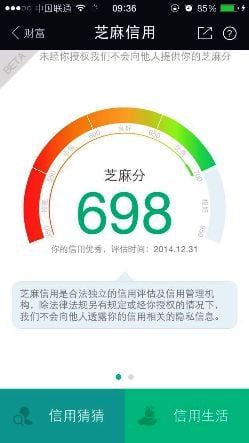
A screenshot from the Sesame Credit app, showing score 698 on a scale from 350 to 950.In the West, our credit score is simple. It’s our ability to pay. It’s measured from our assets, our income, and if we have bought on credit in the past and managed it well. That’s it. In China, the situation is… morenuanced. It’s not just that you have bought things, it’s also what you buy that contribute to your credit score, in either direction. If you’re buying things that the regime appreciates, like dishwashers and baby supplies, your credit score increases. If you’re buying videogames, your score takes a negative hit.
Anybody can check anybody’s credit score using the site Credit China, which again helps people disconnect from people who significantly draw down your own credit score: they’re listed as such. All 869,582 of them.
In theory, Sesame Credit (and its benefits) is optional. So far. For the time being. But China has already announced that it, or something very like it, will become mandatory from 2020. It has also announced that while there are benefits today for obedient people, it intends to add various sanctions for people who don’t behave, like limited Internet connectivity. Such people will also be barred from serving in certain high-status and influential positions, like government official, reporter, CEO, statistician, and similar.
Things that will make your score deteriorate include posting political opinions without prior permission, talking about or describing a different history than the official one, or even publishing accurate up-to-date news from the Shanghai stock market collapse (which was and is embarrassing to the Chinese regime).
But the kicker is that if any of your friends do this — publish opinions without prior permission, or report accurate but embarrassing news — your score will also deteriorate. And this will have a direct impact on your quality of life.
“Sesame Credit, however, also uses other data to calculate the scores, such as a person’s hobbies, interaction with friends, shopping habits and lifestyle.” — Quote from China Daily Asia
The KGB and the Stasi’s method of preventing dissent from taking hold was to plant so-called agents provocateurs in the general population, people who tried to make people agree with dissent, but who actually were after arresting them as soon as they agreed with such dissent. As a result, nobody would dare agree that the government did anything bad, and this was very effective in preventing any large-scale resistance from taking hold. The Chinese way here is much more subtle, but probably more effective still.
This scheme is far more sinister than it seems at first, as you’re also getting assorted immediate privileges based on this credit score:
If your credit score reaches 600, you have the privilege of an instant loan of about $800 without collateral when shopping online.
At a score of 650, you may rent a car without leaving a deposit.
At 700, you get access to a bureaucratic fast track to a Singapore travel permit.
And at 750, you get a similar fast track to a coveted Schengen visa.
There are many more examples – these are just to illustrate.
Do you see what’s happening here? This means that people need to choose between that coveted European vacation and keeping in touch with their old friends who are disagreeing with the regime’s opinions openly. This means that staying in touch with dissidents will cause you and your family to lose out on social benefits. As a result, this will very effectively isolate and neuter anybody who posts unofficial political opinions or unofficial history facts. They’ll effectively be sent into social exile, based on everything they do, write, think, and discuss online.
What China is doing here is selectively breeding its population to select against the trait of critical, independent thinking. This may not be the purpose, indeed I doubt it’s the primary purpose, but it’s nevertheless the effect of giving only obedient people the social ability to have children, not to mention successful children.
People sometimes mock the notion that we’re not at a 1984 level yet. I wonder what it’ll really take to make such people realize that the 1984 point of surveillance has long come and gone.
Privacy remains your own responsibility.
H/t Kit (in Swedish).
UPDATE: Here’s a link to the official directive (in English) to construct this Chinese “social credit score” by 2020. As commented on Hacker News, this Sesame Credit appears to be a trial for the official requirement. Link added inline to text above as well.