Monday, November 30, 2015

China moves decisively on global warming - Part 2


China moves decisively on global warming

Part 2

China is the most populous country in the world, with 1.3 billion people. In little more than a generation, its rapid industrial development has made it the world’s second-largest economy. Over the past three decades, this has made it possible to lift 500 million Chinese out of extreme poverty.
This transformation in the lives of the people took place as China became the factory of the world, producing everything from clothing and digital devices to machine tools, giant construction cranes and merchant ships. But to power that factory required a tremendous increase in its ability to generate electricity.
According to the U.S. Energy Information Administration, by 2012, China had surpassed the U.S. in total electricity generation — 4,768 terawatt hours versus 4,048 TWh for the U.S. By 2014, China’s electric output had risen even further, to 5,523 TWh.
China has little oil or gas, but it has a lot of coal. In 2014, about three-quarters of China’s electric power still came from burning coal, even though the country had risen to first place in the world in installed wind power and second place in solar power.
Thus, the tremendous increase in China’s productive capacity came at a great price to the environment. Burning coal resulted in serious air pollution, especially in China’s eastern cities, where the majority of the people live. It also released CO₂ gases into the atmosphere.
Around 2007, China surpassed the U.S. as the world’s largest emitter of greenhouse gases. However, historically and also per capita, the U.S. remains by far the biggest contributor to global warming.
These are some of the factors that have made the leaders of China commit to the most ambitious program of developing nuclear power of any country in the world today.
nuclearbadge
Graphic: popatomic.org
Nuclear power produces zero greenhouse gases. Unlike solar and wind — which only generate power when the sun is shining or the wind is blowing — nuclear energy is a constant, not intermittent, producer of power around the clock.  
In November of last year, China’s State Council published an “Energy Development Strategy Action Plan” for the period 2014 to 2020. The plan aims to cut the country’s reliance on coal and promote the use of clean energy. It calls for the “timely launch” of new nuclear power projects on the east coast and for feasibility studies for the construction of inland plants. It also calls for substantially increasing the installed generating capacity of hydro, wind and solar power.
Among the various agencies in the world that monitor economic activity, this action plan is not seen as a mere wish list, subject to the whims of elected officials. It is taken seriously, since the Chinese government has consistently carried through with its previously published plans for development, often exceeding its goals.
China goes further for COP21
For 12 days, beginning this Nov. 30, the 21st United Nations climate change conference — known as COP21 — will convene in Paris. So far, 140 countries have submitted their national climate change commitments. It is China’s pledge that has the environmental movement buzzing.
Wrote one news source that focuses on renewable energy: “China, a major powerhouse for renewables, has pledged to reduce the carbon intensity of its economy by 60 percent, peak its emissions and generate a fifth of its electricity from clean sources by 2030.
“Clean energy investment in China already marked a 32 percent jump last year to hit the staggering USD 89 billion (EUR 78 billion), more than any other country in the world, according to estimates of Bloomberg New Energy Finance.
“China plans to boost installed capacity of wind power to 200 gigawatt and solar power to around 150 GW by 2020, up from around 100 GW and 35 GW respectively, last reported in June.” (SeeNews, Oct. 15)
This very specific pledge was received with much enthusiasm by climate scientists around the world, as it showed that China, a huge country that is trying to entirely eradicate poverty, is building protection of the environment into its plans for development.
Even as China invests billions of dollars in hydroelectric, wind and solar power, and improving the grid that brings electricity from areas with more wind and dams to areas with more people, it still finds it necessary to greatly expand its nuclear capacity if it is to reduce its reliance on fossil fuels.
U.S. nuclear plants: old and profit-driven
In the United States, more than two-thirds of the electric power is produced by burning fossil fuels — mainly coal and natural gas. For years, the energy giants financed campaigns to belittle and even deny that climate change exists. Nevertheless, popular awareness of the dangers of global warming has grown. In September 2014, hundreds of thousands of people participated in the People’s Climate March in New York City, calling for  phasing out fossil fuels.
At the same time, there has been much popular opposition to nuclear power. Unlike in the rest of the world, nearly all the nuclear plants in the U.S. are privately owned by for-profit corporations, and there is the justifiable fear that they will skimp on safety costs in order to boost their profits.
No new nuclear power plants have come online in the U.S. for almost 20 years. The last one was Watts Bar 1 in Tennessee in 1996. Some, like Shoreham on Long Island and Vermont Yankee, have been forced to shut down after large protests.
The average age of a U.S. nuclear power plant is now 36 years. Many of these old plants have dubious safety records; all use earlier and more dangerous types of nuclear technology than what is now available in the world.
After 40 years, the owners of these plants are required by law to seek a new license from the federal government or shut down. However, at least one such reactor at Indian Point, within 35 miles of New York City and close to a geological fault, is now more than 40 years old, yet is still operating, even as a political struggle goes on between state and federal officials over whether a new 20-year license should be issued.
Climate catastrophes worsen
Meanwhile, the terrible dangers to the world resulting from global warming continue to multiply. Many more lives have already been lost to hyperstorms, floods, landslides, drought and extreme heat than to all the nuclear accidents. Species are going extinct. Oceans are warming and fish are disappearing. The Greenland ice cap is melting — and could add many meters to existing sea levels in a relatively short period of time.
Many scientists are looking to newer third- and fourth-generation nuclear power as an indispensable part of the answer to global warming. One of them is James Hansen, who began warning Congress about climate change in 1988, when he was head of NASA and had access to satellite data showing the melting of the polar ice caps and mountain glaciers. Hansen ultimately resigned his NASA position in order to campaign for safer technologies.
In November 2013, Hansen and three other scientists wrote an open letter calling for sharply reducing the burning of fossil fuels. In it they said: “Global demand for energy is growing rapidly and must continue to grow to provide the needs of developing economies. At the same time, the need to sharply reduce greenhouse gas emissions is becoming ever clearer. … We understand that today’s nuclear plants are far from perfect. Fortunately, passive safety systems and other advances can make new plants much safer … and solve the waste disposal problem by burning current waste and using fuel more efficiently.”
They concluded, “With the planet warming and carbon dioxide emissions rising faster than ever, we cannot afford to turn away from any technology that has the potential to displace a large fraction of our carbon emissions.”
Ironically, the new technology these scientists refer to was first developed in the U.S. at the Argonne National Laboratory between 1984 and 1994. But the Integral Fast Reactor program was shut down by the U.S. Congress just two years before completion.
Today, China has made this fourth-generation nuclear reactor a reality.
Next: Why China can do what the U.S. couldn’t.

Global warming, nuclear power and China, Part 1

Global warming, nuclear power and China, Part 1

Deirdre Griswold posted on October 26, 2015


In a surprise move, China and Britain’s Conservative Party government have signed an agreement in which China will participate in the building of nuclear reactors in England. Criticism of the deal comes from those, including members of the British Labor Party, who claim that China’s participation could compromise the “national security” of this NATO member-state.
China General Nuclear Power Corp., a state-controlled corporation, will provide $6 billion toward the completion of the Hinkley Point C power station, giving China a 33.5 percent interest in the plant.
Until now, the plant has been primarily a project of the French company EDF. It has been over-budget and long-delayed in its construction, prompting criticism from anti-nuclear groups over money they say could have been spent on developing other renewable energy sources. However, China’s entry into a consortium with EDF, with Britain’s approval, has revived the project.
In the contract just signed, China will only be supplying technology to EDF to build Hinkley Point C, but the deal opens the way “for China to invest in future British nuclear projects and possibly to play a larger role in building the plants, giving more credibility to the Chinese nuclear industry and perhaps helping it to sell more nuclear plants abroad.” (New York Times, Oct. 21)
Britain has not built a new nuclear power plant since 1995. However, its aging nuclear infrastructure contributes almost 20 percent of the country’s electric power. When completed in 10 years, Hinkley C “is intended to meet around 7 percent of Britain’s current electricity needs and run relatively cheaply for at least 60 years.”
Adds the Times: “China has by far the most ambitious nuclear building program in the world, with 68 commercial reactors under construction or in the planning stages, according to the World Nuclear Association, an industry group. China has received help from the French and the big Japanese company Toshiba but has gradually developed its own local designs and built up a large chain of domestic suppliers.
“Industry executives say this building boom means that Chinese nuclear contractors have gained considerable knowledge and experience, which they hope to apply outside China.”
Nuclear vs. burning of fossil fuels
Today, the burning of fossil fuels is the main source of electric power around the world.
Just days after the announcement of the China-British nuclear deal, a hurricane with the strongest winds ever recorded in the Western Hemisphere hit the Pacific coast of Mexico. Amazingly, no lives were reported lost, but it was a chilling reminder of the growing frequency of superstorms as global warming continues.
With the stronger storms, prolonged droughts, and melting of glaciers and polar ice caps that have accompanied record-high world temperatures, there is no longer any doubt that the burning of fossil fuels, which has created a warming blanket of carbon dioxide in the Earth’s atmosphere, must give way to other forms of energy if even greater disasters are to be avoided.
Nuclear plants produce no carbon dioxide (CO2). While many today are looking to nuclear energy as one of the alternatives to fossil fuels, that is not how it got started. The successful splitting of the atom came on the scene long before anyone was aware of the CO2 problem.
Rather than being developed as a source of energy for peaceful purposes, the first nuclear programs were rushed into production for political and military reasons: to build atomic bombs. The first use of the bomb — to incinerate hundreds of thousands of Japanese civilians at the very end of World War II — allowed the U.S. capitalist ruling class to claim the role of leading power in the postwar world.
It soon became clear, however, that the energy in the atom could be a virtually unlimited source of electric power. The first nuclear reactor to generate electricity was built by the U.S. government in 1951. However, the focus of U.S. research continued to be military, aimed at providing nuclear power for Navy submarines and aircraft carriers.
While Washington was mainly funding research for war purposes, the Soviet Union in June 1954 put into operation the world’s first nuclear plant to generate electricity for the civilian power grid at Obninsk, 160 miles south of Moscow.
It was followed by England, which started up its first commercial nuclear power station in 1956, named Calder Hall.  Not until December 1957 was the first U.S. commercial nuclear plant opened in Pennsylvania, called the Shippingport Reactor.
It soon became clear that there were many inherent problems in the first two generations of nuclear plants. Some were immediate, including the possibility of a disastrous failure in the cooling systems.
The accident at Pennsylvania’s Three Mile Island nuclear power plant in 1979 caused no deaths, but there was great apprehension over the release of radioactive elements and the possibility that the accident could have led to a complete meltdown of the plant. Since then, two other major accidents have occurred — at Chernobyl, in the Ukraine area of the then-Soviet Union, and at Fukushima in Japan, after damage to the nuclear plant there from a major tsunami. The total number of immediate deaths from these two accidents came to less than 50.  Estimates of the long-term mortality due to radiation exposure vary widely.
The other major issue involved in nuclear energy is long-term: what to do with the radioactive waste products.
Problem of radioactive waste
As both military and commercial reactors began to proliferate, investigators found that the storage of nuclear wastes — which could continue to be radioactive for hundreds of thousands of years —  was being done so poorly that there could be serious effects on people and the environment.
The problem of what to do with radioactive waste continues to be a huge barrier to the use of nuclear energy. It is the main stated reason why the German government under Chancellor Angela Merkel has abandoned its nuclear power plants and is spending hundreds of billions of dollars to decommission them. Germany now gets about half its electricity from coal, which is the worst polluter in terms of CO2 emissions.
As of 2014, the U.S. got about 19 percent of its electric power from nuclear energy. But the vast majority of it, 68 percent, came from fossil fuels: coal, gas and oil. Only 13 percent came from hydroelectric and other renewables.
China gets most of its electric power from coal and has a very serious air-pollution problem. At present, it has 28 nuclear power reactors in operation, 23 under construction, and more about to start construction. Additional reactors are planned, including some of the world’s most advanced, to give China more than a threefold increase in nuclear capacity to at least 58 GWe by 2020-2021, then some 150 GWe by 2030, and much more by 2050, according to the World Nuclear Association.
What has transformed China, which was a war-torn, impoverished country at the time the U.S. dropped the first atomic bombs, into such a powerhouse for nuclear energy? And are there reasons to believe that its reactors will be safer than those of the past?
Next: China’s energy program, including its fourth-generation Experimental Fast Reactor, which is powered by “spent” nuclear fuel from earlier reactors.
Personal disclosure: The author lives five miles from two of the U.S.’s aging and dangerous commercial nuclear reactors.


Sunday, November 22, 2015

At least 21 miners killed in Heilongjiang coal mine fire

At least 21 miners killed in Heilongjiang coal mine fire

A coal mine fire in the north-eastern province of Heilongjiang has killed 21 miners, with one of 38 miners working underground at the time still missing, according to the official Chinese media.
The fire broke out late on Friday evening, 20 November, at the Xinghua Coal Mine in the city of Jixi, near the Russian border. It is believed the fire started on a coal conveyor belt but the exact cause is still under investigation.
The mine was owned and operated by the troubled Longmay Mining Group, the state-owned conglomerate which reported losses of six billion yuan last year and, in September this year, announced plans to lay off 100,000 employees, about 40 percent of its workforce.
The sign above the entrance to the Xinghua Mine which states “Miners are Great, Labour is Glorious, Life above All.”
Heilongjiang has a long history of major coal mine disasters, including the Dongfeng Coal Mine explosion in 2005, which killed 171 miners, and the Chengzihe mine disaster, also in the city of Jixi, which killed 115 miners in 2002.
The Xinghua fire is third mine disaster in the province so far this year. In July, at least four miners were killed in a flood at a coal mine in Hegang, while two workers were killed in another coal mine flood near Qitaihe in June this year.
The overall accident and death rates in China’s coal mines have declined steadily from around  6,000 deaths per year a decade ago to just under one thousand last year. However, accidents are still a regular occurrence: China Labour Bulletin’s Work Accident Map has recorded 40 coal mine incidents so far this year, a rate of nearly one every week.

Tuesday, November 10, 2015

China, rising wages and worker militancy

China, rising wages and worker militancy

Workers’ wages in the United States have been stagnant since the 1970s in terms of purchasing power. It is common knowledge that it now takes several wage earners in most working-class families just to meet basic expenses. Meanwhile, low-wage workers are on the move, fighting hard for a higher minimum wage and union representation.
Wages in many countries in Europe are also in the doldrums. And the worldwide capitalist economic crisis that started in 2008 has devastated the economies of countries caught in strangling imperialist debt, from Greece to much of Africa, Asia and Latin America.
But there is one bright spot for workers’ wages — although you would hardly know it if you rely on the commercial media for your information.
It is China.
Steady wage increases
According to all accounts, factory wages in China, which of course started at a much lower level than wages in advanced capitalist countries, have more than tripled in the last decade. Some say urban blue-collar wages have gone up five times in that period. This is not what is happening in other developing countries.
In addition, inflation in China is low — the present annual rate is 1.4 percent, making those fatter paychecks very real.
Here are some Western sources from this year:
The Economist, March 4: “Since 2001, hourly manufacturing wages in China have risen by an average of 12 percent a year.”
Imagine if workers here had been getting a 12 percent raise every year for the past 15 years! Even with a union contract, wage increases in the U.S. have barely kept pace with inflation.
The Technology section of the New York Times, April 24: “Waves of migrant workers from the countryside filled China’s factories for the last three decades and helped make the nation the world’s largest manufacturer. But many companies now find themselves struggling to hire enough workers. And for the scarce workers they do find, pay has more than quintupled in the last decade, to more than $500 a month in coastal provinces.”
These reports are directed at U.S. investors, cautioning them that if they want to do business exploiting workers in China, it’s going to cost them more than in the past.
Chinese wages have not zigzagged — they have risen at a very steady pace even as the labor force has increased, especially with people coming from the countryside. Going along with this has been the planned growth of big cities, with new housing, transportation, schools, etc.
Class struggle alive and well
There are two things to consider in these remarkable changes. One is the struggle of the Chinese workers for a better life, and the other is the response of the Chinese government, led by the Communist Party.
The class struggle by the workers against the bosses, many of them foreign corporations, is alive and well in China. Worker actions have grown tremendously.
Nothing deserves the label of U.S. government propaganda more than Voice of America. But here’s what VOA had to say recently about strikes in China:
“The China Labor Bulletin — which tracks disputes — found that there were nearly 1,400 strikes in 2014, and the number of protests has risen even higher in the first two months of 2015.
“’We record strikes and collective work protests as and when they happen, and over the last couple of months we’ve been recording 200 incidents a month, on average,’ explained Jeffrey Crothall, a researcher with the China Labor Bulletin’s Hong Kong office.
“The group recorded 569 protests in the fourth quarter of last year — three times more strikes than during the same period in 2013. The figure also indicates a sharp increase from 2011, when there were only 185 documented labor protests during the entire year. …
“The majority of protesters are demanding higher wages, back pay and greater benefits and pensions. …
“In 1995 China enacted a labor law which granted all workers the right to a wage, rest periods, no excessive overtime and the right to carry out group negotiations. Rapid economic growth in the years since has lifted millions out of poverty, but as the economy cools wages could stagnate and unemployment could rise, and many could start blaming the government.
“Authorities in Beijing, hoping to push local authorities to address the situation, last month issued a notice to local governments to make improving labor relations an ‘urgent task.’ The directive said officials will work to ensure employees are paid on time and in full, launch programs to provide better labor protections for rural migrant workers, and call on employers to improve workplace safety.” (Voice of America, April 9)
To put this in perspective, the Bureau of Labor Statistics in the United States keeps a record of large strikes involving more than 1,000 workers. Last year there were 11 such strikes in the United States, with a total of only 34,000 workers. There used to be hundreds of such large strikes every year, reaching as many as 424 in 1974 and involving 1.8 million workers. But the numbers started to decline in the 1980s.
Executive killed, state took workers’ side
The VOA also noted: “Although many of those participating in the labor protests have been detained, few have been criminally prosecuted.”
To understand the phrase “few have been criminally prosecuted,” here’s one of the most extreme examples: In 2009, an incident occurred involving steelworkers at the Tonghua Iron & Steel Works in Jilin Province in northern China. After a mass meeting addressed by the executive of the steel company that was going to take over their plant, the workers rebelled and beat him to death.
“Chen Guojun, the steel executive who was beaten to death, had threatened 3,000 Tonghua steelworkers with layoffs, which he had said could take place within three days. He also had signaled that larger jobs cuts were likely at the struggling steel mill.” (New York Times, July 26, 2009)
What did the Chinese government do about this? “The provincial government of Jilin ordered Jianlong Group of China to abandon a buyout of state-owned Tonghua Iron & Steel Group after workers protesting job losses killed a manager, state-run Beijing News said Monday. The instruction, announced via Jilin’s television network last night, also ordered Beijing-based Jianlong to never again take part in any reorganization plan of Tonghua, Bloomberg News reported.” (New York Times, July 27, 2009)
That was it. The privatization was halted. No arrests, no prosecutions. Isn’t that the kind of power that workers should have everywhere?
Growth of the working class
At the time of the triumph of the Revolution in 1949, China was an impoverished and war-torn country of 542 million. The vast majority were half-starved peasants, recently liberated from the landlords, who had treated them as little better than slaves.
Today it is a rapidly developing country of 1.3 billion. But it was only in 2012 that China’s urban population for the first time exceeded those living in the countryside. Today the urban share of the working population is above 60 percent.
The rapidly growing working class has many grievances and is not passive. The workers are militant, organized and demanding what they know to be their right: a stable life with decent pay and working conditions.
Since the turn to the right within the leadership of the Communist Party of China in the late 1970s, led by Deng Xiaoping, China has opened up to capitalist ownership. But the recent stock market crash there, which cost many Chinese their savings, showed that illusions about instant riches under capitalism can come up against the basic irrationality of the capitalist system.
The outcome of the crash, just like the big gains being made by the workers, shows something else, too. The state in China does not act the way capitalist states do in the rest of the world. To call China a capitalist country is wrong.
In order to modernize, the CPC has allowed many features of capitalism to exist there, and the capitalists have done despicable things like not paying workers, subjecting them to long hours and unsafe working conditions, etc. The growth of millionaires and even billionaires has fueled corruption of government officials and antagonized the workers.
But alongside the capitalist-owned businesses is an increasingly powerful and modern state-owned infrastructure, through which long-term socialist planning is carried out.
The government was able to stabilize the financial markets in the most recent crash — something capitalist governments cannot do without taking it out of the hides of the masses. How many capitalist countries could survive a drop in the stock market of more than a third without resorting to draconian measures?
Even more important, the state controls the planned development of the country in both economic and social terms.
Organizations struggling for an international agreement on carbon dioxide emissions to counteract global warming were enthusiastic when, at the end of June, China made public its detailed plan for economic development over the next several decades. While still allowing for China’s growth, it laid out exactly how the country will move away from fossil fuels as well as, for example, reforesting vast areas to sequester carbon now in the atmosphere.
No capitalist country has presented any such commitment to the future. How can they, when the corporations and banks are in vicious competition with each other to control and use all the levers of government to enhance their own profits, above everything else?

Friday, October 30, 2015

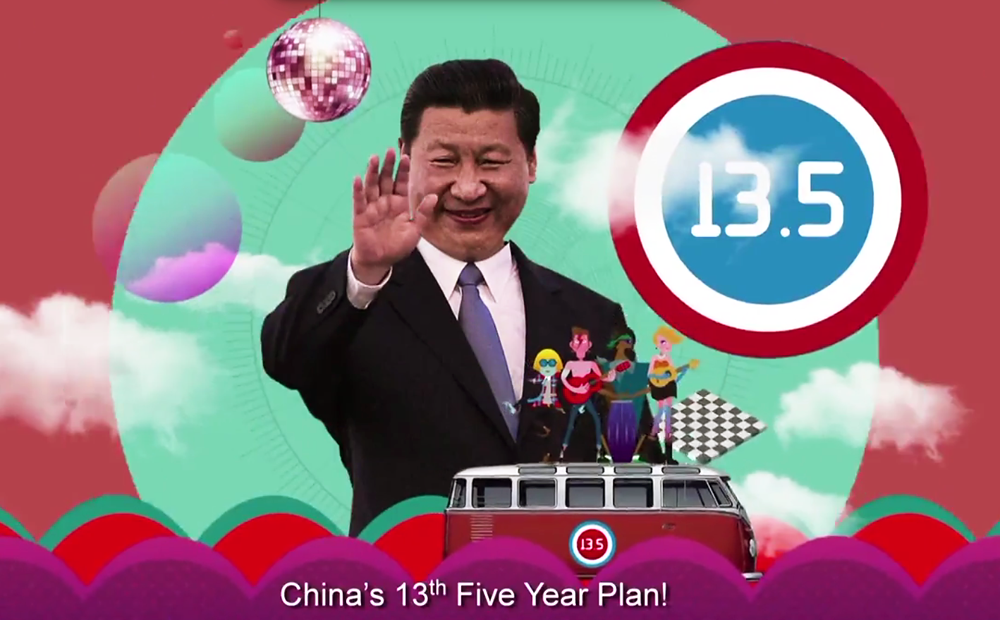
An animated English-language video and song has been produced by China

An animated English-language video and song has been produced by China's propaganda department to promote the nation's next five-year economic and social plan. Photo: Xinhua“Hey, have you guys heard what’s going on in China? President Xi Jinping’s new style? Yes and there’s more …”
China’s propaganda machine is trying a new tack this week to publicise its economic and social plans by using an animated hipster pop music video – complete with a guitar-strummed song performed in American accents by four cartoon characters as they stand on top of a retro Volkswagen van.
The aim of the video, produced by a mainland animation studio that often works on state propaganda, is to tell English-speaking foreigners about the nation’s latest five-year social and economic plan that is being discussed behind closed doors by the Communist Party this week.
http://www.scmp.com/sites/default/files/styles/486w/public/2015/10/27/xijinping-xinhua.png?itok=ElVM
“Every five years in China, man. They make a new development plan. The time has come for number 13, shi-san-wu [13-5], that’s what it means! ...
“Wanna know what China’s gonna do? Best pay attention to the shi-san-wu!”
The video features one of the four cartoon characters with a lightning bolt across his face, just like singer David Bowie's Aladdin Sane persona, plus a cameo appearance by scientist Albert Einstein.
It was promoted by state media on Xinhua News’s Twitter on Tuesday, but can also be found on major video websites, too.

Suntory brewery workers in China force their trade union to take a stand

Suntory brewery workers in China force their trade union to take a stand

Workers in at least three breweries in eastern China owned by Suntory Holdings went on strike last week after the company announced it was pulling out of its loss-making joint-venture with China’s best-known brewery Tsingtao.
Concerned about their job security, employees in Shanghai, Kunshan and Lianyungang staged a series of protests which eventually forced their trade union representatives to take a stand and side with the workers.
In Kunshan, workers blocked the factory gate holding signs stating “we want an explanation; we want to defend our rights”. One worker protested “after more than ten years of service, they just sell the factory when they please.” See photo below.
At the Shanghai plant, the enterprise union filed an official complaint with the company, asking for clarification of the compensation package being offered to employees. Suntory responded that it was simply selling its shares to its joint-venture partner and that employment conditions would remain unchanged and, as such, there was no need to offer any compensation for contract termination.
The disgruntled workers gathered in the cafeteria to discuss the company’s reply. One man climbed on to a table to denounce the company offer and announced the start of a campaign of resistance. The other workers responded with applause and shouts of approval.
The Shanghai workers were quickly joined by colleagues in Lianyungang who posted a photograph of them demonstrating solidarity with and support for their fellow workers in Shanghai. See photo below.
Workers said the union response at Kunshan and Lianyungang had also been supportive of workers’ demands but was more timid, choosing methods other than joining the strike. The two breweries have now resumed work without a clear response from the company.
The Suntory union response, while limited, at least was on the side of the workers and may encourage other unions in the industry to adopt a more pro-worker stance in the future. However, the failure of the union to foresee or preempt the Suntory sell-off clearly demonstrates just how weak and ineffective the vast majority of enterprise unions in China are.