Wednesday, January 13, 2016

Thousands of taxi drivers in several major cities strike over fees, unfair competition

Thousands of taxi drivers in several major cities strike over fees, unfair competition

Thousands of taxi drivers in at least 13 Chinese cities have staged strikes and protests over excessive fees and unfair competition from ride-hailing app services since the beginning of the year.
The biggest protest occurred in Nanjing, with an estimated 13,000 drivers taking part at its height. Caixin reported that the strike, which began on 8 January, was still in force on 12 January. Drivers demanded a reduction in the crippling fees extracted by local government-backed taxi companies.
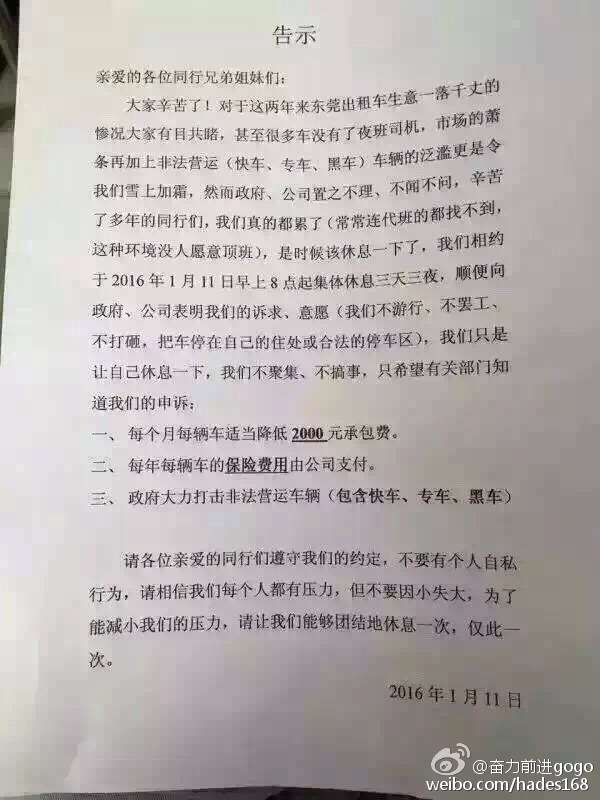
In Dongguan, around 1,000 drivers have been on strike for three days demanding that taxi companies lower rental fees and take over drivers’ insurance payments. They also called on the government to crackdown on ride hailing services such as domestically-owned Didi Kuaidi and foreign competitors like Uber.
Taxi drivers on strike in Dongguan
Hundreds of drivers in neighbouring Shenzhen had earlier staged a two day strike on the same issue that ended on 6 January when the municipal government agreed to pay drivers a 1,000 yuan monthly subsidy to compensate them for increased competition from drivers using ride-hailing apps. Drivers who returned to work immediately were promised a monthly subsidy of 2,000 yuan.
The failure of many city governments to properly regulate the taxi market, combined with the lack any effective trade union representation for taxi drivers, has often led to drivers’ frustrations boiling over into violent actions.
On 11 January, drivers in Nanchang, the provincial capital of Jiangxi, flipped over a car belonging to a ride app driver and faced off against lines of riot police outside the city government building. The confrontation ended with several arrests and injuries. Meanwhile, in Xinyang, Henan, taxi drivers surrounded and assaulted a ride app driver in a coordinated action on 9 January.
At the most fundamental level, all these taxi driver protests are related to local government mismanagement of the industry and long-term exploitation of drivers by cab companies. The recent introduction of ride-hailing apps has only served to exacerbate these long-standing problems.

Thursday, January 7, 2016

Chinese drone maker unveils human-carrying drone

See, that's the difference between Chinese drone makers and US drone makers. US drone makers make drones to KILL people. Chinese drone makers make them to MOVE people. LOL

Chinese drone maker Ehang Inc. on Wednesday unveiled what it calls the world's first drone capable of carrying a human passenger.
PHYS.ORG

Strikes and protests by China’s workers soar to record heights in 2015

Strikes and protests by China’s workers soar to record heights in 2015

The number of strikes and worker protests in China escalated dramatically towards the end of 2015 as the economy continued to stutter, with manufacturing, construction and mining all seeing a massive upsurge in disputes.
China Labour Bulletin’s Strike Map recorded 2,774 incidents for the year as a whole, double the 1,379 incidents for 2014. This increase can be accounted for partly by better data tracking but the upward trend towards the end of the year is still very obvious. See table below.
The increase in strikes and protests began around the time of the 11 August yuan devaluation and subsequent stock market crash and continued to build during the final quarter of the year as the economy showed little sign of improvement.
However, the economic downturn only partially explains the increase in labour disputes. The fundamental cause has been systematic failure of employers to respect the basic rights of employees, such as being paid on time and receiving their legally mandated benefits, and the failure of local government officials to enforce labour law.
More than two thirds of all the disputes recorded in 2015, for example, were related to the non-payment of wages. Wage arrears have been endemic in the construction industry for decades but are now increasingly evident in manufacturing, mining and services as employers simply refuse to pay workers or close their businesses down and disappear.
Only 168 disputes last year were specifically related to demands for higher wages, and many of these incidents were sparked by a sudden pay cut. In 2012, when the economy was healthier, by contrast, demands for wage increases accounted for about 30 percent of all labour disputes, albeit from a much smaller data set.
The construction industry accounted for 36 percent of all incidents in 2015 with manufacturing at 32 percent. The transport industry saw five disputes on average every week, mostly related to unfair competition from unlicensed taxis, but its overall proportion fell to around nine percent. See chart below.
Just about every region in China saw labour unrest last year but in the manufacturing sector strikes and protests were very much centred on what used to be known as the “factory to the world” in Guangdong. Of the 886 incidents recorded in the manufacturing sector last year, 267 were in Guangdong, 181 more than the next highest total of 86 in Jiangsu.
Guangdong also led the country in the number of police interventions in labour disputes, accounting for about 19 percent of the total 831 incidents in which police were deployed and 24 percent of the incidents in which arrests were made.
On 4 December, Guangdong police detained seven prominent labour activists who had been instrumental in resolving numerous disputes. The crackdown however has done little to stem the tide of labour unrest in the province, with another 56 incidents recorded in the province in December alone.
As Foshan factory worker Zhu Xinhua noted:
Workers will either silently swallow insult and humiliation or alternatively they will do much more extreme things such as blocking roads in order to get back their money since there will be no one to tell them what they should and should not do and how to fight for their rights legally.
Worker protests accounted for 38 percent of all mass protests by Chinese citizens last year, according to statistics published on the well-respected Wickedonna blog.

Monday, December 14, 2015

Elderly sanitation worker’s death shows need for collective action and solidarity

Elderly sanitation worker’s death shows need for collective action and solidarity

Sanitation workers in the southern city of Guangzhou have had considerable success over the last few years in taking collective action to improve their pay and working conditions.
However, the tragic death of Wang Shoucun, a 70-year-old sanitation worker in the northern city of Datong, underscores the fact that far too many elderly cleaners and street sweepers are still vulnerable and unprotected.
Although he was well beyond retirement age, Wang took a job two years ago at a refuse processing station in Datong in order to support his impoverished family. He earned just 1,500 yuan a month, was required to live on-site and be on duty 24 hours a day, seven days a week, whenever a delivery was made to the refuse station.
On the morning of 14 October, Wang reached for what he thought was a water bottle and drank the contents. The bottle contained an industrial solvent known as 1,2,3-Trichloropropane. Wang collapsed and was rushed to the local emergency room. However the hospital failed to realise the severity of the situation and released Wang the same evening.
When Wang started to vomit blood the next day it was already too late. The local hospital said he had serious liver failure and would have to go to Beijing, more than 350 kilometres away, for specialist treatment.
Wang Shoucun in hospital. Photo courtesy the Wang family.
Since Wang was not insured, his family had to borrow from relatives and loan sharks to pay the 140,000 yuan in medical bills charged by the Beijing military hospital he was taken to. Wang’s son and two daughters made repeated trips back to Datong to ask the sanitation company for help but they didn’t get a penny.
After eight days, the hospital stopped treatment because the family ran out of money. They were forced to take Wang back to his hometown in the countryside of Datong where he died on 28 October.
Wang’s family is trying to get compensation from the local social security authority, claiming that Wang’s death was work-related, and are seeking legal aid from the local trade union federation, but so far to no avail.
The family are unlikely to get work-related injury compensation however because Wang was well-over the statutory retirement age and many local governments and courts have argued that post-retirement-age employees are no longer protected by labour law. Instead, they claim that elderly workers are merely service providers.
In one case in the southern city of Foshan in 2013, five elderly sanitation workers who were demanding compensation for wages in arrears and years of unpaid overtime, social insurance contributions and other allowances were told by the courts that they were not eligible for compensation because they had already exceeded the statutory retirement age.
This is a serious problem because elderly workers make up a huge proportion all sanitation workers in China. Not only are they poorly paid and have to work long hours in hazardous conditions, they have next to no legal protection.
The number of street sweepers killed or badly injured in traffic accidents every month, for example, is startling. In November alone, CLB’s Work Accident Map recorded 13 incidents in which sanitation workers were killed or injured by moving vehicles. Many of these workers were elderly, came from poor families and had no medical insurance.
As individuals, these workers, like Wang Shoucun, are in a very vulnerable position. However, as the Guangzhou sanitation workers have shown, taking collective action can bring about positive results.
Most recently, a group of 40 sanitation workers in the district of Shatou were able to end their precarious agency labour existence and sign new contracts directly with the cleaning company that employed them. This followed a long-running dispute in the University Town area of the city in which around 200 workers took collective action to force the boss to come to the negotiating table.
In both these cases, it was the well-established and respected Panyu Workers Service Centre that was instrumental in helping the workers take collective action and defend their rights to decent pay and proper employment contracts.
The centre’s director Zeng Feiyang, and staff members Zhu Xiaomei and Meng Han are currently being held in police custody as part of sustained attack in labour groups in the Guangzhou area.

Friday, December 11, 2015

China promises rights to citizens born in violation of one-child policy

China promises rights to citizens born in violation of one-child policy
About 13 million people will be permitted to register for ‘hukou’, documents allowing access to education and healthcare long denied to them

 A slogan in Hebei province calls on residents to ‘pay attention to one-child policy’. China says it will now allow millions born in violation of that policy to get official documents. Photograph: China Stringer Network/Reuters
Agence France-Presse in Beijing
Thursday 10 December 2015 05.15 GMTLast modified on Thursday
 Save for later
China will allow millions of unregistered citizens – many of them children born in violation of the one-child policy – to obtain documents vital to secure education and health services long denied to them, state media reported.

China reforms hukou system to improve migrant workers' rights

An estimated 13 million Chinese, or 1% of the country’s total population, do not have proper household registration permits, or “hukou”.
Some of them are orphans, but many more are people born in violation of the highly controversial “one-child policy”, which restricted most couples to only one offspring, and barred any extra from being registered unless their parents paid a hefty fine, which many could not afford.
Known as “black children”, they are unable to go to school or obtain formal employment, and often have problems travelling, among other difficulties.
The policy’s replacement with a two-child rule for all was announced in October, and the government promised to “fully resolve the hukou registration problem for unregistered people” at a meeting chaired by president Xi Jinping on Wednesday, according to a statement released by the official Xinhua news agency.

Call for China to free labour activists or risk backlash from frustrated workforce

“It is a basic legal right for citizens to lawfully register for hukou,” the statement said. “It is also a premise for citizens to participate in social affairs, enjoy rights and fulfil duties.
“We will deal with and protect every citizen’s rights to permanent hukou registration according to the law,” it added.
Enforcement of the family planning policy has always varied across China, and a few local authorities have already said they will start granting hukou to people whose parents have not paid the fines.

But the new policy will still have to be implemented area by area, and some families have previously complained that no changes have been made “on the ground” no matter what reforms were promised by higher officials.

Wednesday, December 2, 2015

Pregnant women workers struggle to defend their rights in China’s factories

Pregnant women workers struggle to defend their rights in China’s factories

Yin Jing was one of the lucky ones: A Beijing appeals court ruled on 5 November that she had been illegally fired because she was pregnant, and ordered her employer to pay her 62,237 yuan in compensation.
Yin had been employed at a Beijing shopping mall since 2009 and had even been promoted to counter manager because of her outstanding performance. But in 2014, soon after she told her supervisor that she was pregnant, she was transferred to another shopping mall way out in the suburbs on the other side of town.
“It takes three hours to get there using public transport. That would be unbearable while pregnant,” she told Labour Midday News (劳动午报). When she refused to take up the post she was dismissed for disobeying company directives.
Yin refused to back down and sued her employer for illegal dismissal. Yin was lucky because she had clear documentary evidence in the form of text messages that proved her employer was aware that she was pregnant when they transferred her to another store.
For the court, the evidence was incontrovertible and the law was very clear. Article 27 of the Law on the Protection of Women’s Rights and Interests states that:
No entity may, for the reason of matrimony, pregnancy, maternity leave or breast-feeding, decrease a female employee's wage, dismiss her or unilaterally terminate the labour (employment) contract or service agreement, with the exception that the female employee requests to terminate the labour (employment) contract or service agreement.
And Article 29 (3) of the Labour Law clearly states that an employer may not rescind a labour contract of female employees “during pregnancy, childbirth or while nursing.”
Despite ample legal protection, most women who are fired when they become pregnant still struggle to defend their rights because, unlike Yin, they cannot produce concrete evidence that they were fired because they were pregnant or simply cannot afford the time and money needed to go to court.
Sacked workers from the Gaoya Jewellery factory take their case to the Guangzhou Federation of Trade Unions.
Employers can very easily appeal rulings against them and prolong the legal process for months, even years, in the hope that the plaintiff will eventually give up or accept a reduced offer.
Moreover, as labour activist Zhu Xiaomei explained, many factory bosses are already very adept at getting around the law and making life difficult for pregnant workers:
“Pregnant women workers face three main problems,” Zhu said. “First; factory managers often force them to leave by using tricks like transferring them to positions not suitable for pregnant women, or finding fault with everything they do. Eventually the workers just leave because they can’t take it anymore.”
Secondly, many pregnant workers only get paid their basic wage because the boss refuses to let them work overtime. Factory workers in Guangdong rely on overtime and bonuses just to get by, Zhu said. No one can survive in the Pearl River Delta on just a basic wage of 1,500 yuan per month.
Finally, women having a second or third child are often denied their statutory 98-days maternity leave by their employer because they cannot obtain a family planning certificate for that additional child.
Many women workers want to take a stand against their employer’s intimidation tactics but they lack the time and resources to do so. One middle-aged worker, Xu Yanqing described how:
They started picking holes in everything I did; being harsh to me in order to make me quit so they didn’t have to pay any compensation. They only granted me one week’s leave. I told them it was impossible to complete the whole maternity process in one week but they just said that was not their concern.  
Xu thought about going to labour arbitration but that could have taken months to complete and even if she was successful, she said, the compensation she would get was unlikely to be more than a few months’ salary.
Eventually, Xu decided to accept the three and a half months' salary being offered by the factory and left. "What else could I do? The best thing for workers like me is to get the compensation," she said.
Meanwhile, Foxconn, the world’s largest electronics manufacturer has reportedly introduced anexpectant mothers’ production line at its Shenzhen factories. Pregnant workers do not have to wear uniform; they can set their own work hours and their own production targets. See photo below. However, very few other manufacturers offer such facilities, and even at Foxconn, it is not clear how much the workers on the expectant mothers’ production line will actually get paid.
Foxconn’s production line for expectant mothers. Photograph from the Guangdong Provincial Trade Union

Monday, November 30, 2015

What makes China able to plan for the future Part 3

What makes China able to plan for the future

Part 3

In Parts 1 and 2 of this series, we have discussed the phenomenal rise of the People’s Republic of China as a major world manufacturer and what has fueled its growing economy. Since China has more coal compared to other fossil fuels, it has relied — like the United States — on coal for most of its energy.
But coal is one of the worst generators of greenhouse gases. As China rose to become the number one manufacturer in the world, it also surpassed the U.S. in greenhouse gas emissions — although not on a per capita basis. That dubious distinction still belongs to the U.S.
Now, at a time when global warming has been clearly identified as the major threat to our environment, China has laid out very detailed and ambitious plans to move away from fossil fuels and toward renewables. It will continue to expand its solar and wind capacity, but a more significant source of energy now embraced by Chinese planners is nuclear.
In the U.S., there is much opposition to nuclear energy. Nearly all the plants here are privately owned and operated for profit. There is much justifiable fear that the profit motive will override safety considerations, especially as these plants are old.
China is a young nuclear power. It has no old plants. By contrast, the average U.S. nuclear plant was built 36 years ago when reactors were subject to dangerous accidents, especially if something damaged the cooling system — as happened to the General Electric reactors in Japan’s Fukushima nuclear power plant. However, China has the benefit of many improvements in reactor design developed by scientists since then.
The IFR- Integral Fast Reactor.
Ironically, one of the designs China originally pursued was worked on at the Argonne National Laboratory in Idaho from 1984 to 1994. Called the Integral Fast Reactor, it takes a very different approach than the light water reactors then in use. Several books on the subject explain that the great advantages of the IFR, also called a fast breeder or fourth-generation reactor, involve safety and solving the problem of nuclear waste.
The IFR, instead of being water-cooled, uses a passive system to cool the reactor. If anything happens to interrupt the working of the reactor, it will passively shut down. No human intervention is necessary.
The IFR, also known as a closed nuclear fuel reactor, can burn up to 99 percent of the energy in uranium, leaving very little radioactive waste. This contrasts with the light water reactors, which use only 1 percent of the energy in enriched uranium, leaving the rest as waste to decay over hundreds of thousands of years. Even better, the newer reactors could run on the waste left behind by the older reactors, thus helping clean up the vast amounts of radioactive materials that have presented a danger for many, many generations to come.
The Argonne scientists were certain they were in the process of developing a safe technology for powering the world. However, in 1994, Washington suddenly shut down the program to build the IFR, just three years before its scheduled completion.
Leading the charge in Congress against the project was then-Senator John Kerry. The scientists involved were baffled and outraged. Many saw the hand of the oil, gas and coal lobby in the shutdown. One can only imagine their frustration today as the dire news about the consequences of global warming make headlines.
In the meantime, three other countries have succeeded in developing functioning fast-breeder reactors. Today, China, Russia and India all have them, after years of testing involving pilot projects. The expense of developing and building these fourth-generation reactors has been borne by the governments involved.
When the Argonne IFR program was shut down in 1994, neither the U.S. government nor any of the privately owned U.S. energy companies were willing to lay out the large sums of money that would be needed to develop a new, safer generation of nuclear power.
The U.S. today has by far the most nuclear power reactors in the world — 99, operated by 30 different power companies. But they are old. Almost all the nuclear-generating capacity in the U.S. comes from reactors built between 1967 and 1990. Only five new reactors are under construction, and they are all light water reactors.
By 1990, the U.S. had already gone to war in oil-rich North Africa and Southeast Asia against Iraq. That was just the first in a series of conflicts, from Iraq to Syria to Libya, that held the promise of vast profits for the military-oil-banking-industrial complex — especially since it’s the public, not the energy companies, that pays for these wars. Whatever the outcome, the war budget doesn’t come out of their bottom lines.
For the hundreds of millions of people living in North Africa and West Asia, the result of these wars for oil has been a disaster. Is any more proof needed than the millions of refugees now risking their lives trying to find somewhere to live in peace?
And the whole world is affected. The scramble by the imperialist powers, most of all the U.S., to control profitable fossil fuels has precluded any adequate expenditures to develop renewable energy. It would take a massive investment on the scale of what is now spent on imperialist wars for the U.S. to change course and wean itself off coal, oil and gas. That’s not going to happen without a revolutionary change in class relations.
Why socialist planning is necessary
The World Nuclear Association summarizes China’s nuclear power development as follows:
“China has 30 nuclear power reactors in operation, 21 under construction, and more about to start construction. Additional reactors are planned, including some of the world’s most advanced, to give more than a threefold increase in nuclear capacity to at least 58 GWe by 2020-21, then some 150 GWe by 2030, and much more by 2050. The impetus for increasing nuclear power share in China is increasingly due to air pollution from coal-fired plants. China’s policy is for closed fuel cycle. China has become largely self-sufficient in reactor design and construction, as well as other aspects of the fuel cycle, but is making full use of Western technology while adapting and improving it.”
The rich imperialist countries accumulated their wealth generations ago by grabbing much of the world’s resources and super-exploiting workers in the global South. So how is it that a developing country like China can forge ahead with a nuclear program that promises to outdistance them in every way?
The answer lies in China’s ability to control and plan the central components of its economy, especially the infrastructure on which all other activity is based. While the Communist Party and the government made a decision decades ago to allow private ownership of many types of commercial enterprises in order to amass the capital they needed for growth, they have not surrendered ownership and control of the land, the sources of energy, the means of transportation and communication, and other essential elements underpinning modern life.
This allows government economic and social planners, scientists and technical people — not beholden to any private interests — to work together, look ahead and make decisions based on solving immediate and anticipated problems. The government is then tasked with carrying out these plans. While the existence of for-profit enterprises and very rich capitalists can impede this, leading to corruption of many officials in China, the planning principle remains strong.
This is how workers’ wages have been increased on a very steady basis for at least the last two decades. Even U.S. publications like the New York Times and Wall Street Journal acknowledge thatin the last 10 years alone, wages in China have increased fivefold. In the same period, workers’ wages in the U.S. have actually declined in constant dollars, even as the income of the capitalists has soared exponentially.
This is also how the Chinese government is able to allocate a great deal of wealth for future development on a sustainable basis. Its planners are able to think nationally and even globally because they are not hamstrung by the immediate profit needs of the dog-eat-dog economic system, in which each enterprise is in a life-and-death struggle against its competitors.
And how did China get to this point?
Through the revolutionary struggle of millions of poor and oppressed people. Many of them were very exploited workers, but a majority were downtrodden peasants, whose life offered nothing but unending toil and brutal punishment by parasitic landlords. Since that revolution and China’s economic growth, hundreds of millions of young people have migrated to the cities from rural areas and become workers. They are organized, educated and demand a better life. From their ranks also come a new generation of scientists and technical personnel.
The Chinese Revolution was victorious because it was led by communists, who saw the potential for China to become great based on the unity of the workers and peasants. Their goal was to get rid of the old and build something new — a socialist society. Despite detours and setbacks, that goal has not been abandoned, and the hard-won fruits of its planning can be seen more clearly as China continues to shake the world.