Wednesday, June 29, 2016

China starts to shift social insurance burden from employers to workers

China starts to shift social insurance burden from employers to workers

China’s Social Insurance Law (社会保险法), which went into effect five years ago on 1 July 2011, was supposed to create a comprehensive social insurance system in which the responsibilities of employees, employers and the government were clearly spelled out.
However, the majority of employers simply ignored their legal obligations to provide employees with a basic pension, unemployment, medical, work-related injury and maternity insurance. Local government officials, likewise, ignored their obligation to enforce the law, leaving hundreds of millions of workers without an effective social welfare safety net.
Now, there is growing evidence that China’s increasingly pro-business government is looking to place the burden of social security firmly on to the shoulders of workers and individual citizens and gradually reduce the limited burden currently carried by employers.
The government’s own figures (2015年度人力资源和社会保障事业发展统计公报) show that in 2015, only 262 million workers, about one third of China’s total workforce of around 775 million, actually had a basic pension, while only 213 million workers had basic medical insurance provided by their employer.
By contrast, there are currently 357 million working age people with a government-backed pension that does not require employer contributions. The urban and rural resident basic pension (城乡居民基本养老保险), created by the merger of rural and urban resident pension schemes in 2014, relies solely on individual contributions from residents backed by limited government subsidies. So while a lot more people may appear to be covered, the absence of employer contributions means that the benefits accrued are token at best. Indeed, official figures show that the average pay-out for the 148 million people receiving pension benefits from the urban and rural resident scheme in 2015 was just 1,432 yuan for the whole year. The average annual pay-out to the 91 million retirees with a basic urban pension contributed to by their employer, on the other hand, was about 20 times higher, standing at 28,363 yuan in 2015.
Responsibility for medical insurance likewise is gradually shifting away from employers towards individual citizens. In 2010, for example, 178 million workers had basic medical insurance from their employer, while 195 million people were covered by the urban resident medical insurance scheme. Five years later in 2015, the number of workers covered by their employer had risen by about 20 percent to 213 million. In the same period however, the number of people covered by the urban resident medical insurance scheme had nearly doubled to reach 377 million.
Unemployment, work-related injury and maternity insurance for employees are obviously tied to the workplace and, as of yet, there are no alternative urban resident-based schemes. There is a proposal to eventually merge maternity insurance with the basic medical insurance scheme but no detailed plans have been published yet.
Social insurance coverage for employees and working age residents in 2015 (millions)
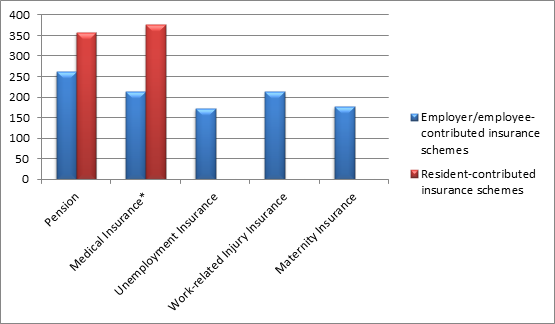
* The figure for resident medical insurance scheme includes those over the retirement age
In addition to emphasizing resident insurance schemes at the expense of employee/employer schemes, the government is gradually chipping away at the insurance contributions employers have to make under existing laws and regulations. A notice jointly issued on 14 April this year by the Ministry of Human Resources and Social Security and the Ministry of Finance (人力资源社会保障部 财政部关于阶段性降低社会保险费率的通知) stressed the need to gradually reduce social insurance contribution rates across the board, with the greatest reductions reserved for the employer. The Notice states explicitly that the measures are aimed at “reducing costs for enterprises and enhancing their vitality.” Several provinces and cities, including Beijing, have already started to reduce employer pension contributionsby one percent from 20 percent to 19 percent. This follows a similar one percent reduction in contributions to unemployment insurance earlier in the year.
CLB’s newly revised and updated introduction to China’s social security system argues that the Chinese government should not reform the system just to make life easier for employers; social insurance is too important for such short-sighted measures. Instead, the government needs to find a way to accommodate the competing interests of labour and capital in creating a realistic and stable social security system; one that looks after workers during poor health and old age but also helps to create a content and well-paid workforce that in turn can help develop the domestic economy through greater innovation, productivity and consumption of goods and services.

Wednesday, June 8, 2016

My Opinion: On Tiananmen anniversary, Tsai calls for political rights

Editor's Note: After the neo-liberal west entered China economically after Deng Xiao-Ping modified socialist ideals to foster faster growth by cooperating with capitalist exploitative ideals failed, so did China let in western ideals of false liberty and "freedom of speech." 

We now know what a lie this "free speech" is thanks to the Erik Snowden and other whistle blowers, the sham elections of the Bushes, and the joke which is Hillary Clinton's obstruction of the public will in demanding real economic change in the U.S. Capitalism cannot be reformed. 

The absurdity of one neo-liberal ruse in Taiwan supporting the attack on socialism in Tienanmen begs the questions:

* Why doesn't Taiwan give its workers better working conditions if their democracy is so much better for the people than China's central planning? 

*Why has the average wage of coastal Chinese workers almost approached and, in some cases, passed wages of workers in "free China? 

*Why have the wages in Taiwan been at a seventeen year stand-still, through an equal amount of KMT and DPP administration while Chinese workers wages have soared so much? 

*Why can workers in China dare to stage strikes and close down their expoliative workplaces but Taiwanese workers hardly ever dare improve their working conditions by striking?


 Foreign investers, from Taiwan, the U.S., Japan, and elsewhere are fleeing China for poorer nations to exploit the slave wage earners there. China is not cheap enough anymore for them. 

Let Tsai Ying-Wen concentrate on improving the lot of Taiwan workers and not be a mouthpiece for failed U.S. influence in Taiwan. Otherwise, soon enough, those sweatshops that fled China might soon be returning to cheaper Taiwan.  


On Tiananmen anniversary, Tsai calls for political rights

Staff writer, with CNA
President Tsai Ing-wen (蔡英文) urged Beijing to treasure Chinese who seek democracy, saying it can earn more respect from other nations by allowing its public to enjoy more political rights, on the 27th anniversary of the Tiananmen Square Massacre yesterday.
Publishing a message on her personal Facebook page, Tsai said she did not mean to criticize China’s political system, “but rather I am willing, with heartfelt sincerity, to share Taiwan’s experience in democratization.”
These were Tsai’s first comments about the 1989 massacre as the president of Taiwan after she took office on May 20.
“Democracy will not fall from the sky,” Tsai said. “The universal values of democracy and human rights are something that is fought for and won by the people.”
Tsai recognized China’s economic progress and the improvement in the Chinese quality of life, which she attributed to the efforts made by “the ruling party on the other side of the strait.”
However, she said it is undeniable that China is facing pressure to reform.
“If the other side of the strait can give more rights to people on the Chinese mainland, it will earn more respect from around the world,” she added.
She also called on China to treasure those who seek democracy, saying that they are likely to be the ones who will move China forward.
Only “the ruling party on the other side of the strait” can heal the past wounds of Chinese, she said.
“My responsibility is to protect the democracy and freedom enjoyed by Taiwanese and create peaceful, stable, consistent and predictable cross-strait relations,” Tsai said.
“Hopefully, one day, the views of both sides on democracy and human rights will converge,” she added.
Former president Ma Ying-jeou (馬英九), who stepped down two weeks ago, also yesterday made remarks about the massacre, where Chinese soldiers and tanks fired on civilians in Beijing’s Tiananmen Square after weeks of pro-democracy protests. Estimates of the death toll range from several hundred to thousands.
In a post on his Facebook page, Ma urged China to hear the diverse voices of the public and treat dissidents well, which he said would help Beijing win respect from people on both sides of the Taiwan Strait and the international community.
Ma said that China would earn more respect from the world by “redressing the June 4 incident.”

Thursday, May 12, 2016

Shenzhen workers conclude collective bargaining deal after ten-day strike

Shenzhen workers conclude collective bargaining deal after ten-day strike

Around 100 workers at a Taiwanese-invested moulding factory in Shenzhen have successfully concluded a collective bargaining deal with management related to a possible change of ownership at the company.
The agreement, signed on 9 May, guaranteed the workers at Hietech Precision Industry (Shenzhen) Co., Ltd long-service compensation in the event of a change of ownership, the payment of social insurance and housing fund contributions in arrears, as well as high-temperature subsidies.
The employees agreed to give management eight months to pay all the money owed, while management agreed not take any kind of retaliatory action against the employees’ bargaining representatives.
Zhang Zhiru, the head of the Chunfeng Labour Dispute Service Centre in Shenzhen, who advised the workers in the bargaining process, said the successful outcome showed exactly why collective bargaining is such an important tool for both workers and management.
The Hietech case shows why labour disputes should be solved through collective bargaining. Solidarity and the spirit of compromise of the workers, the willingness to talk and sincerity of the management, and the active but neutral involvement of the local government, all of these factors contributed to this tripartite success.
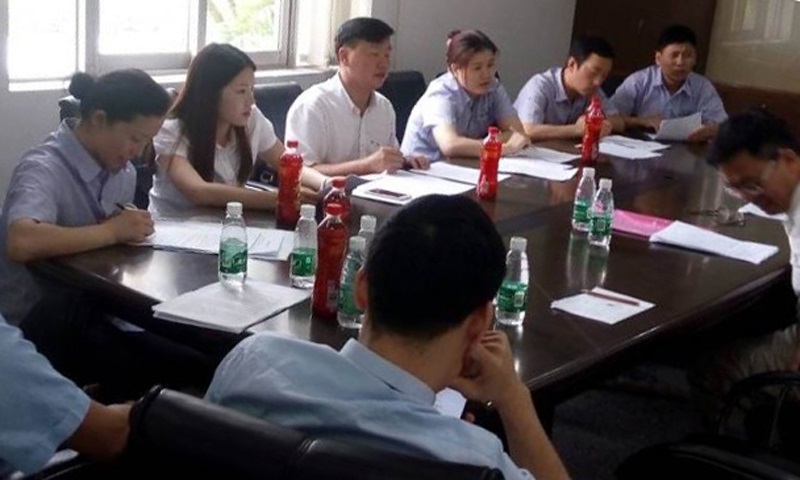
Zhang Zhiru (centre) with Hietech worker representatives during a bargaining session with management
The dispute began last month when workers began to hear rumours about a change of ownership at the factory. Workers, concerned about job security, tried to talk to the boss but failed. They then took things into their own hands and downed tools on 27 April.
Management agreed to some of the workers’ demands on 6 May but did so in very vague terms and didn’t provide a clear timetable. The majority of the workers rejected the deal and continued the strike.
It was only after workers sought help from the nearby Chunfeng Labour Dispute Service Centre that significant progress was made. The workers elected their own representatives and drafted an agreement. Management agreed in principle to the terms of the agreement and the employees returned to work as sign of good faith.
On 9 May, both parties discussed the proposal for a total of 11 hours, ironing out the detail, and eventually signed the agreement. The entire process was documented on social media.
The Hietch disputes once again illustrates how civil society labour organizations can help resolve disputes that have already escalated into strike action by organizing the workers and helping to present reasonable and constructive demands to management.

Saturday, April 23, 2016

Workers on strike at Dongguan factory that once hosted Hu Jintao

Workers on strike at Dongguan factory that once hosted Hu Jintao

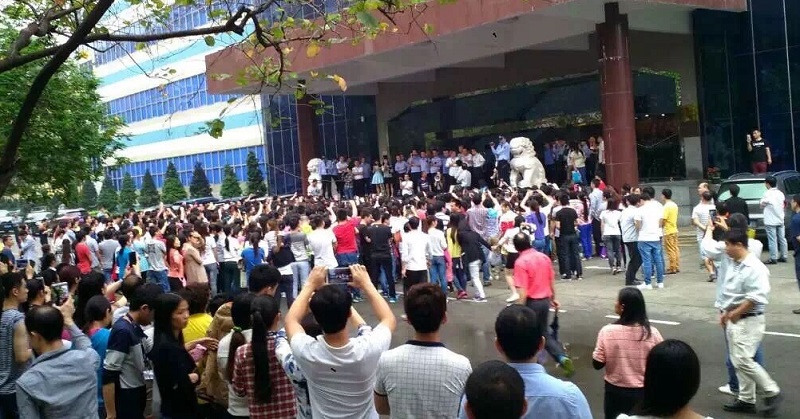
Hundreds of workers at SAE Magnetics in Dongguan have been on strike since Monday 18 April, protesting forced layoffs and attempts by management to avoid paying compensation. (See photo below).
The company, which manufactures parts for hard disk drives and employs around 10,000 workers, announced plans to shut down one large department last week, threatening the jobs of many workers who had been employed at the plant for more than ten years.
The company had initially offered the workers an opportunity to change departments within the factory but the workers said many other departments were on the verge of closure as well.
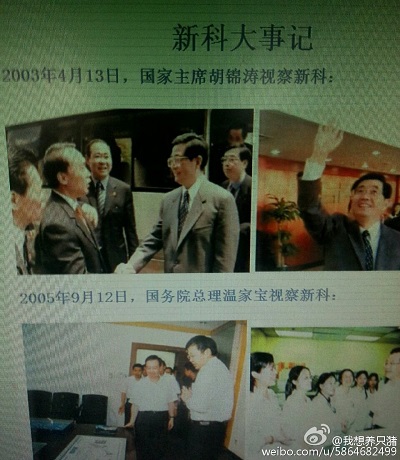
The entire factory, which was once portrayed as a shining example of China’s economic miracle and hosted former President Hu Jintao and former Premier Wen Jiabao in the 2000s (photo left), is now threatened with closure.
The workers demanded full payment of the lay-off compensation they were legally entitled to but got no response from management. As a result, the workers stepped up their actions yesterday and blocked the front gate of the factory. One worker explained:
“Management stole our compensation money so we went on strike! Today is the third day and things still haven’t been resolved, so now our strike will escalate… our boss has such a black heart. Who will protect the interests of us workers?”
Once the workers escalated their collective action it brought an immediate response from the local authorities who had ignored their complaints up until then. Local government officials, flanked by police, arrived at the factory on Thursday but failed to convince the strikers to return to work.
Posts of the strike have been deleted on social media platforms but a flood of information from striking workers continues to come forward.
SAE Magnetics supplies major brands like Western Digital, Samsung and Toshiba. SAE’s headquarters are in Hong Kong and is a wholly-owned subsidiary of Japanese electronics giant TDK. SAE’s websiteshows the company has around 20,000 employees and at least two locations in different parts of Dongguan, the plant in Nancheng and another in Chang’an.
The declining fortunes of SAE Magnetics in Dongguan are emblematic of the municipality as a whole. Once known as “China’s factory to the world,” Dongguan has seen thousands of factories close down or relocate over the last few years. Although some new factories have opened up, the city is still lagging far behind its neighbours Shenzhen and Guangzhou in developing new financial, commercial and service industries.

Sunday, March 20, 2016

Taiwan Demonstrators call for solidarity and support of labor movements in China

Editor's Note:In an affront to Taiwanese workers who suffer union-less work abuses worse that in China, a group of "radicals" was reported to have criticized the Chinese government for suppressing the labor movement there.


By Abraham Gerber  /  Staff reporter
Left-wing demonstrators yesterday rallied in Taipei in support of Chinese labor protests, calling for the Chinese government to allow the establishment of independent labor unions.
About 10 protesters from the Committee for a Workers’ International and the Nan Shan Life Insurance Co union braved rain showers to gather outside the Chiang Kai-shek Memorial Hall’s Liberty Square, calling for capitalists to be made to “foot the bill” for massive layoffs expected in China’s state-owned enterprises.
“We feel that Taiwanese left-wing organizations should do more to support the struggle of the Chinese workers’ movement,” committee member Vincent Hsu (許偉育) said, adding that there had been a rise in labor activism as a result of China’s economic crisis, which he said was slated to lead to the layoffs of up to 1.8 million workers from state-owned corporations in the coal mining and steel industries.
“The Chinese Communist Party [CCP] is doing everything in its power to suppress the workers’ movement and their struggle to get wages that are owed to them,” he said, citing the suppression of miners’ protests in China’s Heilongjiang Province.
While thousands of workers from China’s state-owned Longmay Mining Group are to be paid back wages after taking to the streets early this month, this was only a “partial victory,” because leaders and organizers were still detained, he said, adding that the protests were only the “tip of the iceberg” of growing labor discontent, citing struggles by steel workers in China’s Jilin Province and miners in Shanxi Province.
He called for the establishment of independent unions apart from the CCP-controlled All-China Federation of Trade Unions, which he called a tool for the suppression of workers’ movements.
A Hong-Kong-based protester surnamed Lam (龍) said solidarity and support for Chinese workers’ movements were important, because they could ultimately lead to the overthrow of the CCP if they become politicized.
“If there is no international support for suppressed Chinese workers and no solidarity to join them in their struggle against the CCP and capitalists, the CCP and capitalists will have more and more power to suppress workers in Hong Kong and Taiwan,” he said, blasting the CPP for spending more than 1 trillion yuan (US$154.5 billion) to prop up its stock market while refusing to pay benefits and wages owed to workers.
This story has been viewed 1061 times.

Monday, February 22, 2016

Guangzhou stainless steel factory shut down as strike enters sixth day

Guangzhou stainless steel factory shut down as strike enters sixth day

Several hundred workers at Ansteel Lianzhong in Guangzhou have been on strike for six days, protesting wage cuts and moves by the company to force them to resign. The strikers have now effectively closed down the factory, which has a total workforce of around 2,000.
In response, police have sealed off the factory gates and, this morning, officers in riot gear attempted to break up a demonstration of hundreds of workers inside the factory grounds.
Workers stage a protest inside the Ansteel Lianzhong Steel complex on 17 February
The workers claimed that problems at the plant started last year when state-owned steel giant, Ansteel, took a controlling interest in the formerly Taiwanese-owned Lianzhong Stainless Steel Co.
The new management soon began to lay off staff and increase workloads and then in December, the company started to put workers on leave at 80 percent of the Guangzhou statutory minimum wage.
The final straw came on 15 February when the company issued an open letter announcing a new performance-based pay system that would significantly reduce workers’ wages.  To add insult to injury, it added that the company trade union had already accepted the plan on the workers’ behalf.
Several hundred workers mobilized immediately, collecting money via the WeChat Red Envelope system to pay for banners, loud speakers etc. The strike began on 17 February with workers demanding compensation for contract termination and to sign new contracts with Ansteel directly. The strike spread quickly and by the third day they had effectively shut down production. Large numbers of police with riot gear and busses used for mass arrests arrived at the factory and blocked the factory gates.
On the third day of strike, the head of the company union head was sent by management to meet with workers and attempt to persuade them to accept the deal and return to work. The union head offered to return to the old wage system but workers rejected the offer and ignored the union head.
“How can we trust the company now? How do we know they won’t do these things again?” said one worker. Workers were particularly disappointed in the union’s claims to represent them, saying the union was “absolutely useless. There is nothing democratic about it.”
Workers were outraged at the inability of a large state-owned company to abide by its basic legal obligation to compensate laid off workers: “If you want to get rid of your workers, you just pay them compensation – isn’t that normal?” one said.
In its most recent letter to employees, the company offered to halt the wage adjustment program and asked employees to return to work, threatening those who refused with disciplinary action. As of today, the workers intend to continue their action claiming trust between employer and employees had broken down.

Thursday, February 4, 2016

New Zealand hosts signing of TPP agreement

New Zealand hosts signing of TPP agreement

AFP, AUCKLAND, New Zealand

Protesters and police come face to face as demonstrators close down streets yesterday in Auckland, New Zealand, to express their displeasure after the ministerial representatives from the 12 countries sign the Trans-Pacific Partnership agreement.

Photo: AFP

The biggest trade deal in history was signed yesterday, yoking 12 Pacific rim countries in a US-led initiative aimed at wresting influence from booming China.
The ambitious Trans-Pacific Partnership (TPP) aims to slash tariffs and trade barriers for an enormous 40 percent of the global economy — but pointedly does not include Beijing.
“TPP allows America — and not countries like China — to write the rules of the road in the 21st century,” US President Barack Obama said after the pact was signed in New Zealand.
The deal — whose birth was fraught by domestic opposition in the US and in other key players, such as Japan — is a key plank of Obama’s so-called “pivot” to Asia, as he seeks to counter the rising power of China.
Along with a rebalancing of the US military machine toward the western Pacific, the TPP is recognition of the growing might of China, which has come to dominate the region, threatening US influence.
Supporters of the deal say harnessing the power of free trade in such a dynamic part of the world is vital if the US is to fend off China’s challenge to its supremacy.
Trade ministers from 12 participating countries — Australia, Brunei, Canada, Chile, Japan, Malaysia, Mexico, New Zealand, Peru, Singapore, the US and Vietnam — signed the pact in Auckland early yesterday.
Beijing was muted in its reaction to the deal, saying its officials were studying the 6,000-page document.
China’s Ministry of Commerce statement said Beijing would “actively participate in and facilitate highly transparent, open and inclusive free-trade arrangements in the region.”
Despite Obama’s comments, the US has also sought to play down any overt anti-China rhetoric.
US Trade Representative Michael Froman said the agreement was “never directed against” any specific country and “it’s important to have a constructive economic relationship” with China.
Although the signing marks the end of the negotiating process, member states still have two years to get the deal approved at home before it becomes legally binding.
“We will encourage all countries to complete their domestic ratification processes as quickly as possible,” New Zealand Prime Minister John Key said. “TPP will provide much better access for goods and services to more than 800 million people across the TPP countries, which make up 36 percent of global GDP.”
However, ratification may prove far from easy, notably in the US, where poisonous election-year politics are likely to stymie co-operation over a deal opponents have spun as a job killer.
In Japan — the second-biggest economy in the bloc — mainstream politicians and economists have generally supported the TPP as positive for Tokyo’s export-driven growth, despite concerns over its impact on its prized agriculture industry.
The Canadian government, which has changed since the deal was negotiated, signed up yesterday, but has yet to decide whether to go through with ratification.