Tuesday, November 1, 2016

Born In The U.S., Raised In China: 'Satellite Babies' Have A Hard Time Coming Home

Born In The U.S., Raised In China: 'Satellite Babies' Have A Hard Time Coming Home


Public schools and Chinese community groups in New York City are becoming increasingly familiar with "satellite babies."
Nicole Xu for NPR
Chun Zheng has lived through a house fire, a flood and an earthquake. None of that, she says, compares to sending her infant daughter and son abroad to live with her extended family.
"It's the worst hardship I've ever had to bear," says the 42-year-old hotel housekeeper, speaking in Mandarin.
Both of her children — 7-year-old Joyce and 5-year-old Jay — were born in Boston. But for the first years of their lives, they stayed with relatives in Fujian, a southeastern province of China. Joyce spent more than four years with her aunt, whom she still calls "ma." (She calls Chun Zheng "mommy.")
At the time, Chun Zheng and her husband were living in a cramped room in Boston's Chinatown, sharing a kitchen and bathroom with strangers. She says they worked long hours at restaurants to save enough money to eventually bring their kids home.
"Anytime you eat at a Chinese restaurant in Chinatown, it's likely that somebody in that restaurant has a child who is in China at the moment," says Cindy Liu, a psychologist at Harvard Medical School. She points out that no one knows exactly how many Chinese immigrant families send their babies to be raised by family in China.
That's partly why she helped start a research project focusing on Chinese immigrants in the Boston area who are raising what some psychologists call "satellite babies." Like satellites in space, these children leave from and return to the same spot.
You can find similar arrangements among immigrant communities from South Asia, Africa and the Caribbean, researchers say. The satellite babies of Chinese immigrants usually come back to the U.S. in time for school.

When Satellite Babies Go To School

For their study, Liu and her colleagues interviewed adults who were once satellite babies to try to track the long-term impacts of the experience. Researchers say there are benefits from spending your early years in another country, away from your birth parents. Many satellite babies are exposed to their immigrant parents' mother tongues and often develop strong ties with their grandparents and other extended relatives.
While Liu says that separation between satellite babies and their biological parents does not necessarily harm their relationship, some teachers and principals in New York City, where researchers also see this phenomenon, say these children can sometimes show subtle signs of trauma.

Listen to the story from WNYC

Born In The U.S., Raised In China: 'Satellite Babies' Have A Hard Time Coming Home

"They're always looking around to see who's there with them," says Principal Elizabeth Culkin of P.S. 176 in Brooklyn. "And they always need that sense of knowing where they are and who's there to protect them."
Members of Culkin's staff say sometimes these children may act out by pushing or shoving other students to get attention. There are, of course, language difficulties, and some children show signs of attachment disorders.
Brenda Tang, who teaches kindergarten at P.S. 176, has seen satellite babies in her classroom every year. This year, she spotted 5-year-old Vivien Huang on the first day of school. While most of the other students were busy drawing, Vivien only scrawled a couple of shapes. Her mother, Hong Zheng (no relation to Chun Zheng of Boston), says Vivien returned from China in June.
Hong Zheng's story may sound familiar; she says she took Vivien to live with her grandparents in Fujian province when she was a baby. That way she and her husband could continue to put in long hours working at a restaurant. She did the same when her younger daughter was born a couple years later.
Five-year-old Vivien Huang reads a book in her kindergarten classroom. After being raised in China, her teacher says she's eagerly learning English from picture books.
Jennifer Hsu/WNYC
Though Hong Zheng says she cried for a month after Vivien left, they stayed in touch through video chats.
Now, Hong Zheng says she's quit working to care for the girls, and she's planning to bring her parents to New York City from China because Vivien misses them so much.
"Every morning she demands to video chat with her grandfather," she says in Mandarin.

The Role Of Social Services

In Boston, Yoyo Yau, who directs family and community engagement at Boston Chinatown Neighborhood Center, says she's concerned that parents and their children are often not prepared to be reunited in the U.S.
"That separation is so heavy for the parent to bear because they say, 'I'm the parent here. You should love me. I love you. How we can not do it?' But the child just can't," says Yau, who has organized parenting classes and offered counseling for mothers and fathers of satellite babies.
Similar services exist in New York City. In Flushing, Queens — home to one of the city's three booming Chinatowns — Lois Lee is an evangelist for the cause. She runs a child care program for the Chinese-American Planning Council inside a public school. Lee says the satellite babies she knows often experience a complicated mixture of emotions about leaving one family for another.
"They're angry," she says. "'Why did you send me away? How come my brother's here but you sent me away?' And then they're disconnected."
More free day-care programs, she argues, could encourage parents to bring their children back from China at an earlier age or even prevent families from sending children abroad. Lee says New York City's expansion of universal pre-kindergarten in New York City may be one reason why she's noticed anecdotally more children returning at age 4 instead of 5.
Meanwhile, her solution is to engage children in conversations about their experiences.
During a visit to a class of 8- and 9-year-olds, almost every hand shot up when Lee asked how many children were satellite babies — a term she says they all know. Many have vivid memories about the difficult transition, using the words "upset" and "frustrated" to describe how they felt about moving back to New York. We aren't using the children's names to protect their privacy.
One boy says he was angry because, "My parents lied to me that they were going to visit me" in China. Another says he was frustrated because, "I didn't even know my parents exist" until he got off the plane and they greeted him with gummy bears.
One girl recalls, "I was like, 'Grandpa, grandma, why are you leaving now?' And then my grandmother started crying."
Many of the children seem to understand that they were sent abroad because their parents needed more time to focus on their jobs, often in restaurants or nail salons.
"They didn't have enough money to raise us, to raise me in America," one boy adds.
Researchers say they don't think the satellite babies phenomenon is going anywhere in the U.S. as long as affordable child care stays out of reach for many immigrant families.
Translations provided, in part, by WNYC producers Richard Yeh and Jenny Ye.

Why Some Chinese Americans are taking to the streets to back Trump

At first glance, the crowd outside Trump Tower on Manhattan’s Fifth Avenue could be protesters.
With only days to go until the US presidential election, hundreds of people holding banners and flags hand out fliers and chant slogans.
But a second look at the “Make America Great Again” signs and the red T-shirts with “Chinese Americans love Trump” in English and Chinese make it all clear.
“Is that a protest?” a passer-by asked. “No, wait … Chinese Americans for Trump.”
The event in support of Republican candidate Donald Trump was organised by the New York branch of “Chinese Americans for Trump”, a grassroots volunteer group forged in the heat of this year’s campaign.
The participants in the rally were mainly Chinese immigrants from New York, New Jersey and Pennsylvania. They were mostly middle aged or older and seemed a little uncomfortable trying to explain their support for Trump to passers-by.
But they went out on the streets to air their views on immigration and traditional values.
“We come out because we are very anxious and worried. The United States is in dangerous trouble and the result of this election is critical to us,” retired businesswoman Fu Xiaobo said.

She said the danger was caused by the Democratic Party, with President Barack Obama’s lesbian, gay, bisexual and transgender policies undermining traditional family values and an “open immigration policy” ruining the country’s economy and order.
Lucy Liu, holding a sign saying “Support Trump, Keep Law and Order”, said immigration was also one of her concerns.
Liu said she had witnessed the refugee crisis and terrorist attacks in Paris and did not want the United States to become like Europe.
“I don’t want so many illegal immigrants. They just take so many more social benefits than they pay. We are legal immigrants. We love this country. We work hard and we make contributions,” she shouted at passers-by.
Hong Kong-born Steven Cheung, a real estate broker in his 70s, said Chinese were traditionally very wary of public displays of political views, but he wanted to stand up for his children’s future.
“People should step forward. There is nothing to be ashamed of,” Cheung said. “I vote for policy, not personality.”

Trump’s policies, including his stress on law and order, tax cuts and putting American citizens first were appealing, said entrepreneur Jeffery Liu. Trump also represented the Asian value of pragmatism, hard work and honesty, he said. “He has proven his leadership and capability with a successful enterprise.”
The Trump Tower crowd included at least one member of the Democratic Party. Cardiologist Gary Chen said he voted for Hillary Clinton when she ran for New York State Senate in 2000 and 2006, plus the Democratic candidacy in 2008 but could no longer support her policies.
“I don’t know how good Trump could do, but it’s so clear Hillary is now on the opposite of Chinese Americans’ interests. I cannot vote for her,” he said.
Among the issues cropping up again and again was the Democratic Party’s support for affirmative action which allows more people from underprivileged backgrounds to get a place at university. Some students with Asian backgrounds say it has unfairly penalised their efforts to be accepted at a college, even if they have higher grades.
“We Chinese are always being bullied in the US,” rally organiser Jack Jia said. “We want us to be seen on the mainstream media.”
Investment consultant Howard Chen said the rally was bigger than he expected and an opportunity for the Chinese American community to play a part in politics.
“The Trump rally is also a chance for us to unite. We American Chinese should take part in politics ... and run for local administrations. We are at the bottom of the food chain and we must unite to speak out.”


But one quest for visibility failed. Chinese Americans for Trump groups across the country have chartered planes to fly banners in support of the candidate across different cities. On the day of the protest, however, the view of the “NY Chinese Americans for Trump” slogan flown in the skies above the Hudson River was blocked – by the Trump Tower.

Saturday, September 10, 2016

It's been 40 years since the death of Mao Tse-Tung.

It's been 40 years since the death of Mao Tse-Tung.
What the Chinese people (and the world) knew about the U.S. propping up KMT regime in Taiwan is still true. The working people in China were liberated because of Mao; Taiwanese workers are still oppressed starting with Chiang Kai-Shek's Chinese interlopers and continuing through U.S. neo-liberalism now backing the DPP hindering rapprochement.

https://www.facebook.com/telesurenglish/videos/911255549017848/

Thursday, September 8, 2016

US reaffirms Taiwan stance following Xinhua claims

US reaffirms Taiwan stance following Xinhua claims

Staff writer, with CNA
A US official on Saturday reaffirmed Washington’s stance toward Taiwan, after China’s Xinhua news agency reported that US President Barack Obama expressed the US’ “opposition” to “Taiwanese independence” in a meeting with Chinese President Xi Jinping (習近平) in China.
“Our position is consistent and longstanding... We remain firmly committed to our ‘one China’ policy based on the three joint communiques and the Taiwan Relations Act,” White House National Security Council spokesman Myles Caggins said in an e-mailed statement.
Obama and Xi held a meeting in Hangzhou on the eve of the G20 summit taking place there, and according to Xinhua, Xi urged the US to honor its commitment to the “one China” policy and the three joint communiques, and safeguard the peaceful development of cross-strait ties and the overall interests of Sino-US cooperation with deeds.
According to Xinhua, Obama responded that the US “opposes all attempts aimed at seeking Taiwanese independence,” and reaffirmed that Tibet belongs to China.
“Our fundamental interest is in peaceful and stable cross-strait relations,” said Caggins, who is among the White House staff accompanying Obama in China.
“We believe that cross-strait issues should be resolved peacefully in a manner, pace and scope acceptable to people on both sides of the Strait,” Caggins added.
However, Caggins did not reveal the details of the meeting between the two leaders.
Earlier this year, Daniel Kritenbrink, senior director for Asian Affairs at the US National Security Council, said that Chinese officials often mention the Taiwanese issue during meetings with their US counterparts, and if US officials comment on the issue, they say: “We do not support Taiwanese independence.”

Tuesday, September 6, 2016

At G20, Crisis-Ridden Obama Warns Host China of 'Consequences'

Editor's Note: The U.S. hegemonic belligerence in the world can only cause more harm added to the rest of U.S. started wars. China will not be cowed by the U.S. Asia will not be cowed by the U.S., and, increasingly, the world will not be cowed by the U.S. Most of all, the American people now realize what a filthy corporate government they have. 


Obama lectured China, saying "the United States arrives at its power, in part, by restraining itself."

As a guest of the Chinese government during the G20 Summit, U.S. President Barack Obama issued a threat, saying there would be “consequences” if China did not back down from what he called increasingly aggressive behavior in the South China Sea in an interview with CNN aired Monday.
"Part of what I’ve tried to communicate to President Xi (Jinping) is that the United States arrives at its power, in part, by restraining itself," Obama said.
"So where we see them violating international rules and norms, as we have seen in some cases in the South China Sea or in some of their behavior when it comes to economic policy, we've been very firm. And we've indicated to them that there will be consequences," President Obama said.
The South China Sea is a contested water area where China claims it is part of its sovereign lands, while its neighbors—U.S. allies—have been angered by Beijing’s military presence there.
China has repeatedly warned the U.S. against a military escalation in the area with the excuse of aiding its allies. Xi said Sunday that China would continue to safeguard its sovereignty and maritime rights in the South China Sea.
The waters are important to China because over 40 percent of the world’s trade ships pass through it each day while the sea also contain some of the world’s largest offshore oil and natural gas known reserves.
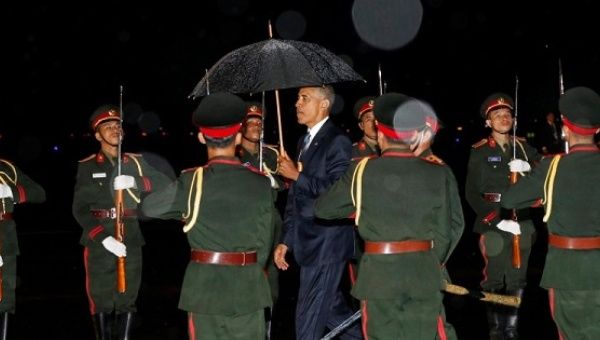
Obama’s latest threats come as he is facing a tricky last G20 where he was poorly received at the airport when he was forced to disembark from Air Force One through a little-used exit in the plane’s middle section after China failed to provide the United States' large entourage with a rolling staircase, as is customary for visiting dignitaries.
The second blow to his visit came after his Filipino counterpart President Rodrigo Duterte called Obama a “son of bitch” and said he would curse him when he met him. He also said he was not “an American puppet” and Washington has no right to criticize him on human rights.
A previously scheduled meeting between the two was cancelled following Duterte’s comments. Since winning the presidency in May, Duterte has been leading an extrajudicial campaign against drug dealers and drug users in the country, killing thousands in a few months time.
Obama also tried to strike a softer tone, saying that China and the U.S. could “be friendly competitors on the commercial side and important partners when it comes to dealing with the many international problems that threaten the two countries."

Sunday, September 4, 2016

U.S. President Meeting in China Gets Reality Check?


Editor's Note:  "Leaders told to 'avoid empty talk' by China's President" was a headline on BBC News about the G20 Meeting. What does the BBC's use of the passive voice mean? 

The active voice is more powerful than the passive voice, especially when the subject is mentioned last. Reading between the lines is the last thing British and US children are taught, especially with Gates and Clinton in charge. Children only feel it instinctively and never know the ulterior motive

HANGZHOU, China — The problems began as soon as President Obama landed in China.
There were no stairs waiting for him to emerge from his usual door at the front of Air Force One.
On the tarmac, as Obama’s staffers scrambled to get lower-level stairs in place for him to disembark, White House press photographers traveling with him tried to get in their usual position to mark his arrival in a foreign country, only to find a member of the Chinese welcoming delegation screaming at them.
He told the White House press corps that they needed to leave.
A White House official tried to intervene, saying, essentially, this is our president and our plane and the media isn’t moving.
The man yelled in response, “This is our country!”
The man then entered into a testy exchange with Obama’s national security adviser, Susan E. Rice, and her deputy, Ben Rhodes, while trying to block them from moving toward the front of the plane.
On what is probably his last visit to China, for a Group of 20 summit here, there were flare-ups and simmering tensions throughout — a fitting reflection of how the relationship between these two world powers has become frayed and fraught with frustration. Over the past seven years, strained ties with China have colored and come to define Obama’s foreign policy in Asia.
On Saturday, several White House protocol officers and other staff members arriving at a diplomatic compound ahead of Obama’s meetings were stopped from entering and had heated arguments with Chinese officials before they could get in.
“The president is arriving here in an hour,” one White House staffer was overheard saying in exasperation.
A fistfight nearly broke out between a Chinese official trying to help the U.S. diplomats and a Chinese security official trying to keep them out. “Calm down, please. Calm down,” another White House official pleaded.
Twenty minutes before the arrival of Obama and Chinese President Xi Jinping, the two sides were still arguing in the room where the two leaders would soon be touting their cooperation. The Chinese insisted that there was not enough space for the 12 American journalists traveling with Obama. U.S. officials insisted that there was, pointing to a spacious area sectioned off for the media and citing arrangements negotiated long in advance.
For all the skirmishes, in the days leading up to the trip, White House officials gave a much rosier depiction of the U.S.-China relationship, talking up mutual efforts such as a deal to address climate change.
But in so many other areas, the world’s two largest economic powers have failed to bridge increasing hostilities and in­trac­table disputes over maritime issues, cybersecurity, trade and human rights. The yelling and screaming Saturday in many ways illustrated just how differently both sides view their roles — and how little has changed since Obama’s troubled first visit in 2009.
High hopes turn to pivot
Obama began with high hopes of improving U.S.-China relations. In 2009, he tried reaching out to Chinese leaders with offers of increased engagement. He decided not to meet with the Dalai Lama to avoid angering Beijing, to the disappointment of human rights advocates. Obama became the first U.S. president to visit China during his first year in office. But his administration was taken aback by how completely the Chinese controlled all aspects of that visit.
“He wasn’t allowed to say much at all,” said Orville Schell, a longtime China scholar who was in China during the visit. “The Chinese kept him from meeting certain people, from taking questions or even radio broadcasts. He didn’t know quite how to respond. He didn’t want to be impolite. It took the U.S. a while to understand that this was the direction China and the relationship was headed.”
Some have blamed Obama for adopting such an overly optimistic and open stance during those early years. For all his outreach, current and former top U.S. diplomats say, Obama got little in return, except the feeling of being burned by Beijing.
But that could be equally attributed to the simple fact that China itself was undergoing a seismic shift during the early years of Obama’s presidency.
When the global recession plunged the world into financial crisis in the late 2000s, China escaped unscathed. Its leaders looked around and realized for the first time just how much power China had achieved in ­becoming the world’s second-largest economy. Shortly there­after, they began eagerly throwing that weight around.
No longer were they willing to make concessions or bide their time — on big things, such as territorial claims, and on smaller ones, such as the nitty-gritty of negotiations over who sits where and says what during diplomatic exchanges.
Obama’s response to this newfound Chinese assertiveness was largely a response to reality. “In a textbook, it would be great to have a strategic vision for how you see things being eight years from now,” said Jeffrey A. Bader, Obama’s top Asia adviser during those early years. “But in this case, I think the word ‘reaction’ is right. You had a China that was changing in capacity and leadership.”
If the carrot of engagement didn’t work, Obama administration officials decided, they would try the stick. And they gave this tougher policy a name: the “pivot to Asia.”
The pivot boiled down to the idea of rebalancing U.S. ­foreign-policy attention from the Middle East to Asia — an area that will have clear long-term strategic importance in coming years.
Those overseeing the pivot strategy, senior U.S. officials said at the time, had studied examples in history when one power was rising while others were declining: Germany’s rise in Europe after World War I; Athens and Sparta; the rise of the United States in the 20th century.
Out of those studies, they developed a belief that China would respond best to a position of strength. To find that leverage, the United States planned to forge stronger ties with its traditional allies in Asia and pick up new allies among neighbors alienated by China’s new aggression — including Vietnam, Burma and India.
Using that multilateral approach, the thinking went, the United States could offset China’s rising military power and assertiveness.
Doubts among allies
The main problem with the Asia pivot was one of perception and substance.
European and Middle Eastern leaders expressed concern at the idea of U.S. attention and priorities suddenly shifting from their regions to another. Chinese leaders saw the pivot as a U.S. conspiracy to interfere with China’s goals and to slow its rise.
Meanwhile, the very Asian allies the pivot was meant to reassure had their doubts as well. Many wondered how much of the pivot was empty rhetoric and how much it would be backed by economic and military substance.
In recent months, those doubts have resurfaced because the ­Trans-Pacific Partnership — a multinational trade agreement with Asian allies that Obama hopes to enact this year — may die for lack of support in Congress and from presidential candidates Hillary Clinton and Donald Trump.
Meanwhile, in the years since the pivot strategy began, the U.S.-China relationship has soured.
Both countries are trying to avoid open hostility but are increasingly wary and frustrated with each other. Other countries in the region continue to fear China’s rise but are not fully convinced that the United States will be a sufficient counterweight.

Editor's Note: For the arrogance and condemnation the U.S. government spews in the media about China, logistical errors were turned into insults in the western media so that the would think America got an "in your face" at the reception; it is all an exaggeration and provocation. Read the following article from to see how things were twisted to make China look mean and rude.


The U.S.-China relationship may be the biggest problem Obama’s successor will face in Asia. How the next president deals with it — the exact proportion of carrots and sticks chosen and the Chinese response — will probably define the region in the decade to come.
If this visit by Obama is any indication, the situation is unlikely to improve anytime soon.
On Saturday, even as the two presidents finished their talk and prepared for a nighttime stroll toward Obama’s motorcade, Chinese officials suddenly cut the number of U.S. journalists who could cover them from six to three, and finally to one.
“That is our arrangement,” a Chinese official flatly told a White House staffer, looking away.
“But your arrangement keeps changing,” the White House staffer responded.
In the end, after lengthy and infuriating negotiations, they settled on having just two journalists witness the leaders’ walk.
Neither side was happy with the compromise.
David Nakamura in Washington contibuted to this report.